
Seabed Warfare
Part I — The World's Umbilical Cord
Military Intelligence · March 2026 · How 97% of internet, 100% of SWIFT and $2.5 trillion daily hang from cables thinner than a fist, at 4,000 meters depth, with no army protecting them.
RED LANHAI STATUS (March 2026): The Lanhai network covers >60% of the Indo-Pacific with beacon density of 1 node every 50-100 km. AJX-002 drones communicate with it without surfacing. The swarm is already on the ocean floor. Sensors analysis, metamaterials and the Transparent Ocean → Part III.
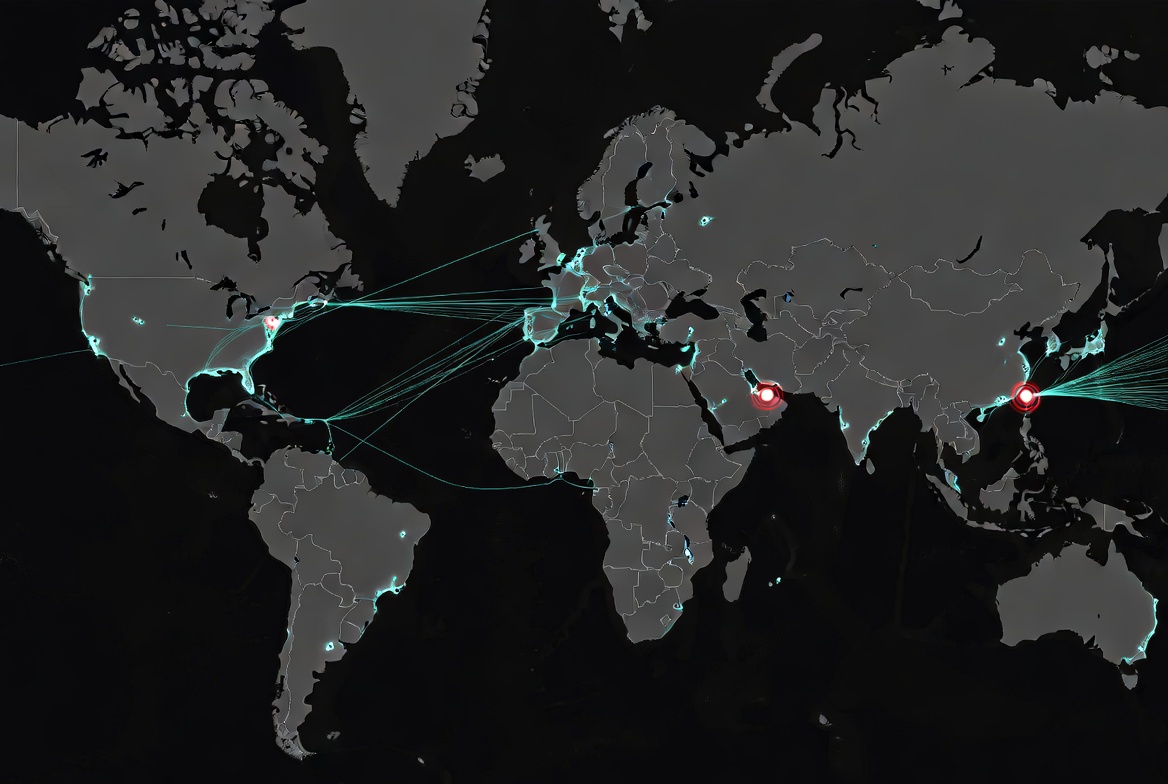
🗺 SCHEMATIC MAP — Indo-Pacific Submarine Cable Network
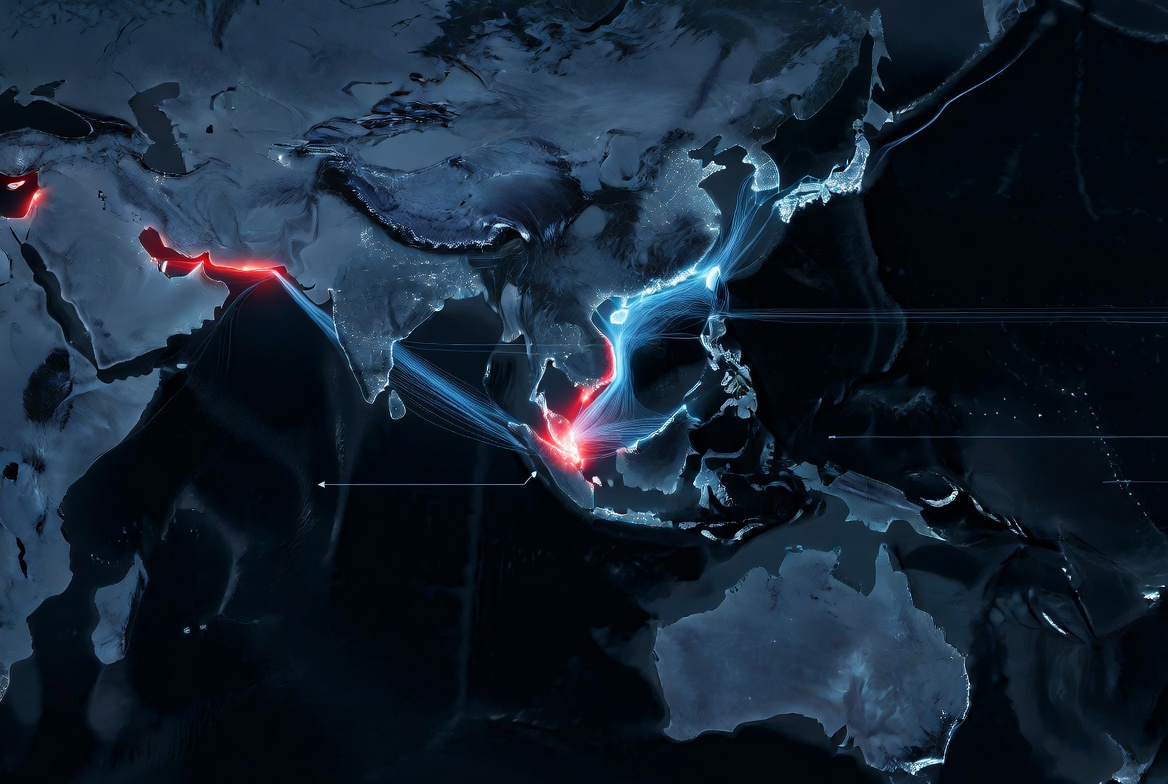 Indo-Pacific submarine cable network. Chokepoints (Hormuz, Malacca, Bab-el-Mandeb) concentrate 40% of global data traffic. Source: TeleGeography 2026.
INTELLIGENCE ASSESSMENT
The most destructive weapon of the 21st century has no nuclear warhead. It costs less than a Porsche. It operates at 4,000 meters depth. And it is already deployed.
You are reading this thanks to a cable. A glass cable, the thickness of a pen, lying on the Pacific floor at 4,000 meters depth. China has a robot with a diamond disc that can cut it in 5 minutes. Nobody protects it. Welcome to the critical infrastructure of the modern world.
The Invisible Scaffold of the Digital World
There is a brutal paradox in the architecture of the internet. The network that the West presents as the supreme symbol of freedom, borderless information and decentralized power rests, 97% of it, on physical cables. Fiber optic cables lying on the ocean floor, at some points more than 8,000 meters deep, with no active protection, managed by private consortiums and serviced by fewer than 60 repair vessels on the entire planet.
And it's not just internet. 100% of SWIFT transactions — the instructions that move money between banks worldwide — travel through those same cables. The stock markets of New York, London and Tokyo. The logistical coordination of global supply chains. The unencrypted military communications between NATO bases. Everything. In cables the thickness of a human arm.
That is the umbilical cord of the modern world. And in 2026, China has not only the scalpels to cut it, but the doctrine, the fleet and the infrastructure to do so in a massive, simultaneous and undetectable manner.
DEFINITION: Seabed Warfare
Seabed Warfare is a military doctrine encompassing all offensive and defensive operations on the ocean floor with the objective of attacking, protecting or exploiting critical submarine infrastructure: communications cables, pipelines, energy interconnectors and sensor networks. Unlike traditional submarine warfare (oriented toward combat between military platforms), seabed warfare primarily targets civilian infrastructure. Its defining characteristic is plausible deniability: it operates in a domain where attribution is technically difficult, legally ambiguous and internationally unregulated. In 2026, no international treaty explicitly prohibits submarine cable sabotage in peacetime. China knows this. And has built a complete operational doctrine around that legal gap.
DEFINITION: Submarine Fiber Optic Cable
A submarine fiber optic cable is a multi-layered conduit that carries light signals between continents. At its core are glass fibers just 0.25 mm in diameter capable of transmitting data at speeds up to 400 Tbps (Terabits per second). To protect that fiber at depths of up to 8,000 meters, the cable incorporates multiple layers: protective gel, Mylar layer, high-tensile steel cables and polyethylene sheath. In shallow water (less than 1,000m) additional metal armor is added. However, beyond 2,000 meters, the premise was that depth provided natural protection — a premise that Chinese 2025-2026 developments have invalidated.
• Total thickness: 17–69 mm by depth
• Glass fibers: 0.25 mm diameter
• Max speed (Amitie cable): 400 Tbps
• Total active cable length: ~1.4 million km
• ~500 active cables worldwide
• 97% of world internet traffic
• 100% of SWIFT transactions
• ~35× the Earth's circumference in length
The Chokepoints: Where the World Breaks
Submarine cables are not evenly distributed across the ocean floor. They concentrate in geographic bottlenecks where dozens of them converge, crossing the same 100 kilometers of ocean floor. A coordinated attack on those nodes doesn't interrupt a cable; it interrupts a civilization.
DEFINITION: Chokepoint
In submarine geostrategy, a chokepoint is a geographic node where multiple submarine cables concentrate in a small area of the ocean floor, creating a systemic vulnerability: a single attack at that point produces global impact. The term was borrowed from classical naval strategy (straits like Malacca or Hormuz) and adapted to the digital infrastructure domain. In 2026, the three major cable chokepoints are the Luzon Strait, the Bab-el-Mandeb Pass and the Atlantic Triangle off Ireland.
The 3 Critical Global Chokepoints · March 2026
| Chokepoint | Region | Concentrated Cables | Cut Impact | Military Threat |
|---|---|---|---|---|
| Luzon Strait | Taiwan — Philippines | 10+ cables | Taiwan isolation + -80% Hong Kong, Philippines | 7th Fleet US without comms |
| Bab-el-Mandeb Pass | Red Sea | 15+ cables | $2.5 trillion/day stopped · Critical SWIFT latency | Europe-Asia disconnected |
| Atlantic Triangle | Ireland · North Atlantic | 20+ cables | Google/AWS/Microsoft collapsed between US and EU | NATO without command coordination |
A. Luzon Strait (Between Taiwan and Philippines): The data «funnel» of all Southeast Asia. Connects US and Japan with Hong Kong, Singapore and Vietnam. A cut here means near-total digital isolation of Taiwan and severe degradation — up to 80% — of connectivity in Hong Kong and Philippines. US Seventh Fleet military communications would be disrupted.
B. Bab-el-Mandeb Pass (Red Sea): The main corridor between Europe and Asia. Almost all data traffic between London, Marseilles, Bombay and Singapore passes here. March 2026 estimates indicate a total cut would cost $2.5 trillion per day in electronic financial commerce. Critical latency in global financial transactions would paralyze markets within hours.
C. The «Atlantic Triangle» (Near Ireland): Point where transatlantic cables — like Amitie, AEC-1 or Dunant — approach the European continental shelf. An attack here disconnects Google, AWS and Microsoft data centers between US and EU. NATO would lose its real-time command coordination capability.
Thinking of these three points as mere data traffic figures falls dramatically short. The Luzon Strait is not just an internet bottleneck: it is the optical nerve of the US Seventh Fleet. Every operational order, every position coordination, every communication between the USS Ronald Reagan carrier and the Pentagon travels, in peacetime, through those same civilian cables. If they are cut, the fleet does not go blind all at once — it goes blind progressively, while its officers try to determine whether what is happening is a geological accident, a fishing maneuver or the start of a war.
The Bab-el-Mandeb Pass has an economic dimension that demands contextualization: $2.5 trillion per day equals more than France's entire annual GDP concentrated in a week of paralysis. We are not talking about an economic slowdown — we are talking about the collapse of the international payment settlement system. European banks would be unable to confirm whether their Asian counterparties had received transfers. London's oil futures markets would lose connectivity with their Singapore brokers. High-frequency transaction latency would jump from microseconds to seconds — which in practical terms means closed markets, massive margin calls and systemic panic within hours.
The Atlantic Triangle, in contrast, has a dimension that transcends the economic to become existential for Western democracies: without this node, NATO loses real-time coordination capability. The coordination of collective defense — Article 5 made operational — requires millisecond latency between capitals. In an active conflict, falling back to backup satellite communications means multiplying latency by a thousand and reducing bandwidth by a million. This is not an operational inconvenience. It is the equivalent of trying to direct a battlefield battle using carrier pigeons.
The Strait of Hormuz is not only the global oil chokepoint — it also concentrates critical submarine cables between the Persian Gulf and Asia. We analyzed it in depth in The Ormuz Theorem. The oil+data duality makes Hormuz the planet's greatest strategic vulnerability point.
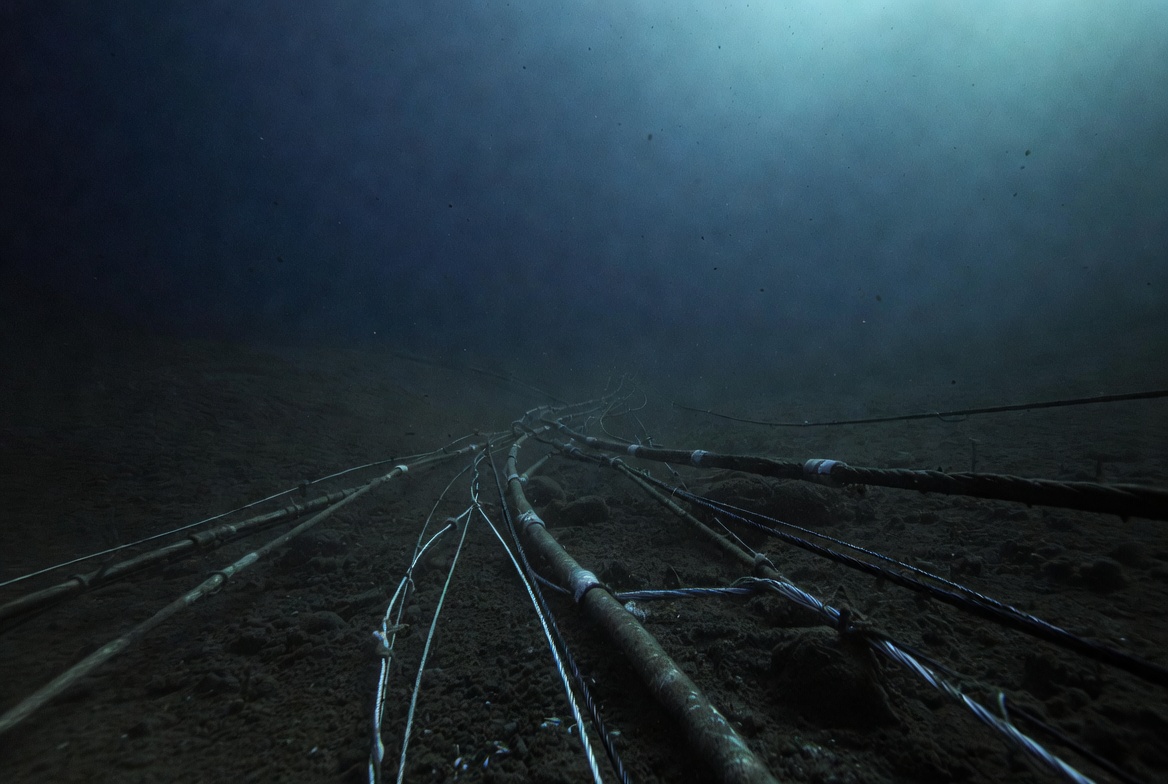
The Weapon: Diamond Disc at 4,000 Meters
For decades, the submarine cable industry operated with an implicit security premise: ocean abysses are hard to reach. Most cutting incidents occurred in shallow waters, where anchors and trawl nets could accidentally damage cables. Beyond 2,000 meters, doctrine established that depth was sufficient protection.
In 2025-2026, China completely invalidated that doctrine.
DEFINITION: CSSRC — China Ship Scientific Research Center
The China Ship Scientific Research Center (CSSRC) is China's primary research laboratory in hydrodynamics and submarine systems, under the Ministry of Industry and Information Technology. Founded in 1950, it has evolved from a civilian naval engineering institution to a central actor in China's military submarine program. Its technical publications are scrutinized by Western analysts as indicators of the state of Chinese autonomous underwater vehicle (UUV) systems. The CSSRC is the entity identified by H.I. Sutton (Covert Shores) and other OSINT analysts as responsible for developing the diamond disc cutting module for the AJX-002 and its variants.
The CSSRC cutting module is a circular disc of 150 mm diameter spinning at 1,600 rpm. Mounted at the end of an articulated robotic arm on XXLUUV drones, it can cut steel-armored cables in less than 5 minutes. The operation takes place at 4,000 meters depth, where hydrostatic pressure is 400 atmospheres.
The historical irony is eloquent: the 19th century protected cables under the sea believing nobody would reach them. The 21st century built robots specifically to cut them.
The tactical implication of operating at 4,000 meters goes deeper than mere physical difficulty. At that depth, hydrostatic pressure equals 400 atmospheres — 400 times atmospheric pressure at sea level. No diver can descend. Manned rescue submarines take between 6 and 18 hours just to reach that depth. And in an active war zone, any repair vessel approaching with its dynamic positioning system active becomes a priority target. Depth not only hid the cables — it created the illusion that protecting them was unnecessary. China turned that illusion into strategy.
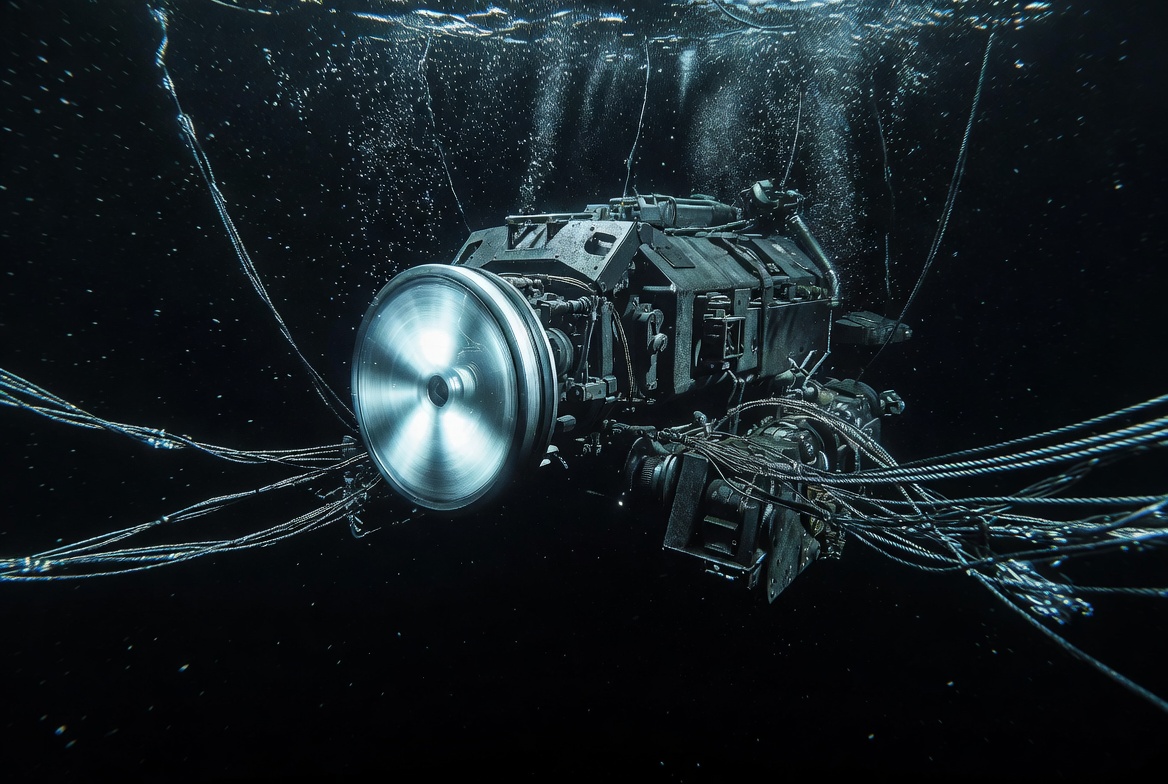
DEFINITION: AJX-002 (First Mention)
The AJX-002 is the main Large Unmanned Underwater Vehicle (XLUUV) of the Chinese People's Liberation Army. Between 12 and 20 meters long, it is designed for covert mining and submarine infrastructure sabotage missions. Its estimated cost ranges from $1.5 to $3 million per unit — a fraction of the cost of the American Boeing Orca ($100M+). See full analysis in Part II — The Arsenal of the Abyss.
Impact Table: Why It's Worse Than a Nuclear Bomb
Western military doctrine is calibrated for visible destruction scenarios: missiles, explosions, casualties. The seabed attack is fundamentally different — it produces invisible, systemic destruction with plausible deniability. The following comparative analysis illustrates why NATO military planners now consider seabed warfare a first-order threat.
Table 1: Impact by Target Type · Seabed Warfare
| Cut Target | Economic Impact | Military Impact | Recovery |
|---|---|---|---|
| Data Cables (Internet) | Digital GDP collapse. Chaos in banking payments and logistics. | Loss of non-encrypted and commercial comms channels. | 7–21 days (if repair ships available) |
| Energy Cables (Interconnectors) | Regional blackouts. Collapse of island/small country power grids. | Inoperability of ground defense bases and radars. | Very difficult — months. Requires heavy laying vessels. |
| Surveillance Cables (SOSUS/Sensors) | Minimal direct economic impact. | TOTAL STRATEGIC BLINDNESS: Enemy moves nuclear submarines undetected. | Impossible in wartime. |
Table 2: Nuclear Attack vs. Seabed Attack — Strategic Comparison
| Factor | Nuclear Attack | Seabed Attack (China 2026) |
|---|---|---|
| Detection | Instant (Early warning satellites) | Diffuse: Was it an anchor? Earthquake? Drone? |
| Response | MAD: Mutually Assured Destruction | Paralysis by analysis and commercial bureaucracy |
| Economic Impact | Localized / Regional | Global and Total — 90% drop in data traffic |
| Recovery | Decades (persistent radiation) | Indefinite if repair vessels are destroyed |
| Attribution | Immediate and certain | Plausible Deniability: months of legal-diplomatic debate |
DEFINITION: Plausible Deniability
Plausible deniability is a strategic tactic that creates enough ambiguity about the authorship of an act to prevent a direct diplomatic or military response. In the context of seabed warfare, it materializes by maintaining a reasonable margin of doubt about whether cable damage was accidental (anchor, earthquake, currents) or intentional. China has perfected this tactic using civilian vessels with flags of convenience and operating at depths where forensic investigation is technically impossible. The result: the West cannot respond militarily without risking action on an unproven 'hypothesis'.
The Global Umbilical Collapse: Worse Than an EMP
China has achieved what no naval power managed: decoupling military power from cost. While the US deploys 3 high-tech Orca units (more than $100 million each), China operates a fleet of more than 200 low-cost submarine drones — AJX-002, HSU-001 and XXLUUV classes.
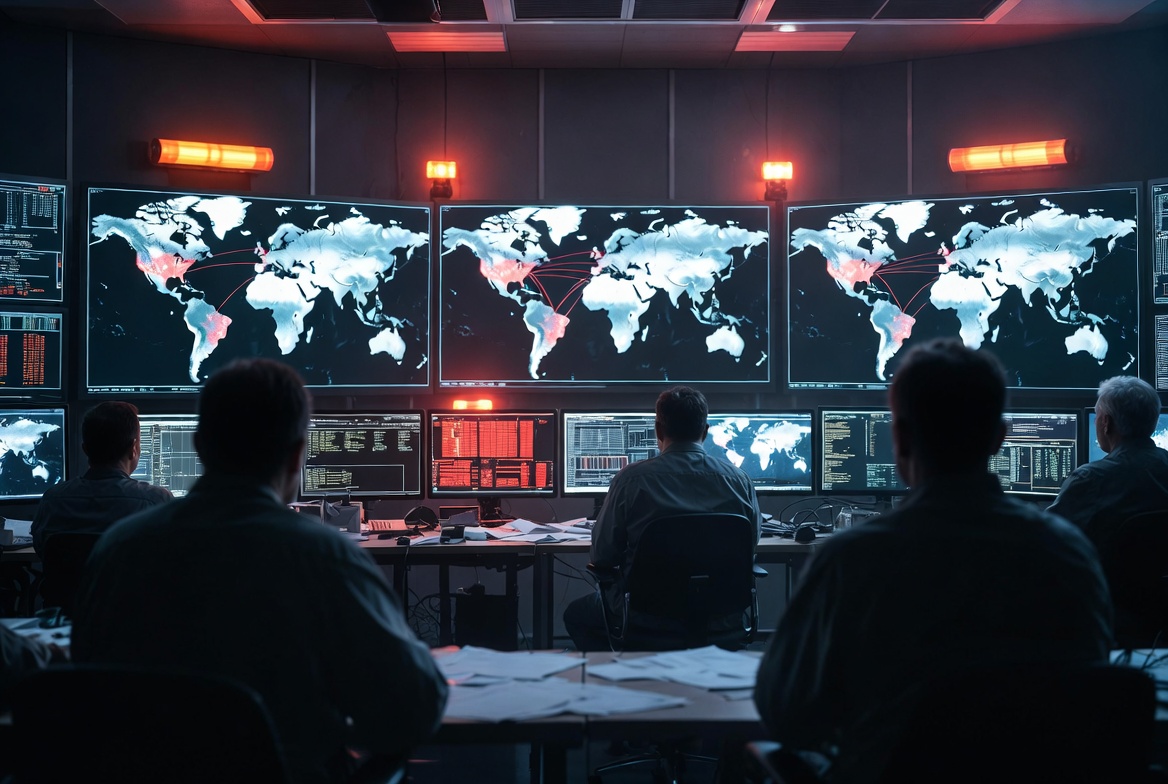
The comparison with an electromagnetic pulse (EMP) or solar storm is illustrative but incomplete. A solar storm damages surface electronics in hours, but equipment can be replaced in weeks. The physical cable at 4,000 meters in a war zone cannot be replaced in less than months — if repair ships are available and not being intimidated by China's maritime militia.
There is another element the EMP comparison fails to capture: the psychological impact on markets. A solar storm is an act of God, with no human agent responsible, no possible negotiation or reprisal. A coordinated cable cut — even if denied — carries the implicit message that someone did it deliberately and can repeat it. That calculated ambiguity is precisely the tool: it does not physically destroy markets on day one, it paralyzes them by anticipation. Investors do not know whether the severed communication will be restored in hours or months. The result is paralysis and capital flight into safe-haven assets — gold, Swiss francs, US Treasuries — before it is confirmed whether the damage is real or a capacity test. China does not need to cut all cables. It only needs the world to know it can.
China's superiority in this matter is not only technical, it is doctrinal. They have understood that to defeat a superpower, you don't have to destroy its cities — you have to cut its connections.
DEFINITION: Critical Infrastructure (CI)
Critical Infrastructure (CI) encompasses the physical and digital systems whose disruption or destruction would have a debilitating impact on national security, the economy, public health or collective security. Classification varies by agency: the US Presidential Directive PPD-21 identifies 16 CI sectors; the European NIS2 directive expands the definition to 18 sectors. Submarine communications cables are classified as maximum-level CI: they combine critical dependency (97% of global internet traffic) with extreme vulnerability (minimal protection, remoteness, slow repair) and multiplier effect (their failure simultaneously collapses banking, communications, logistics and defense).
China's Plan B: Resilience While the World Goes Dark
The strategic asymmetry of the seabed warfare scenario is not only in Chinese offensive capability. It is in the fact that China has designed its infrastructure to survive — and thrive — in the same chaos it can itself unleash.
While the West depends on submarine cables for 99% of its communications traffic, China has built a three-layer resilience plan that would allow it to maintain full operational capacity in a scenario of total collapse of global submarine infrastructure.
THE NETWORK SWITCH — The Asymmetric Advantage
Layer 1: Data Sovereignty — China has migrated its critical services to land-based networks (Digital Silk Road). Its domestic internet doesn't need submarine cables to function.
Layer 2: Cross-Media Communication — Its AJX-002 drones use blue-green laser to communicate with satellites, bypassing the need for cables for military command and control. Analyzed in depth in Part III.
Layer 3: Space Hegemony — With the Guowang constellation, China can maintain its own military internet while the rest of the world returns to the era of shortwave radio.
DEFINITION: Digital Silk Road
The Digital Silk Road (数字丝绸之路) is the technology infrastructure component of the Belt and Road Initiative (BRI). It encompasses the construction and management of submarine cables by Chinese companies (HMN Tech/Huawei Marine), 5G networks in over 70 countries, data centers, satellites and digital platforms. Its declared objective is 'global connectivity'; its real strategic objective is reducing Chinese dependence on Western technology infrastructure and creating a parallel digital ecosystem where China maintains sovereignty advantage. As of March 2026, Chinese companies have participated in the construction of at least 80 submarine cables worldwide, some with dual intelligence capabilities.
DEFINITION: Guowang Constellation (国网)
Guowang (literally: 'National Network') is China's Low Earth Orbit (LEO) satellite constellation, comparable to SpaceX's Starlink. Operated by SpaceSail, it plans to deploy over 13,000 satellites in three phases until 2030. Unlike Starlink, Guowang has no global commercial vocation — it is designed as a sovereignty network: guaranteeing Chinese military and governmental communications regardless of the state of terrestrial or submarine infrastructure. In a seabed warfare scenario where cables are massively cut, Guowang would be the backbone of Chinese communications while the West loses 99% of its capacity.
The research vessel Dong Fang Hong 3 — protagonist of our intelligence fiction series The Kraken of Malacca — is an integral part of China's seabed reconnaissance system. Its oceanographic data feeds AJX-002 drone navigation routes. The Transparent Ocean doesn't start in Beijing — it starts in the seabeds that ships like Dong Fang Hong quietly map.
Intelligence Note: The February 2026 Rehearsal
The simultaneity of the February 2026 incidents was not a statistical accident. A damaged cable in the Baltic is an accident. A damaged cable in the Baltic and another near Taiwan within the same 72-hour period is a message. A message designed to be ambiguous enough not to trigger NATO Article 5 or a unilateral US military response, but clear enough for intelligence analysts to understand exactly what was happening: China was measuring Western response times.
The result of the 'experiment' was revealing. Repair teams took between 11 and 17 days to mobilize toward the affected areas. Submarine forensic investigation — necessary to attribute the cause of damage — required additional weeks. Diplomatic channels remained silent for 48 hours while foreign ministries awaited 'official confirmation'. By the time the West had mapped out a coordinated response protocol, China had already withdrawn its assets and erased any operational trace. The rehearsal was perfect. The gap between Chinese attack capability and Western response capability was not measured in years — it was measured in days.
There is a data point that official reports tend to minimize: in February 2026, available repair teams in the North Atlantic were already partially deployed in the Indo-Pacific attending to previous incidents. The world has fewer than 60 submarine cable repair vessels for the entire planet. China knows this. Saturating that repair capacity — forcing the opening of multiple simultaneous fronts — is a constitutive part of the PLA's seabed warfare doctrine. It is not necessary to cut all cables if you can ensure that nobody can repair them.
The Prototype Swarm: 200 vs. 3
The numerical comparison that most unsettles Pentagon analysts is not the difference in aircraft carriers, missiles or nuclear warheads. It is the difference in submarine drones.
THE DEFINITIVE ASYMMETRY
US: 3 Orca drones ($100M each). China: 200+ AJX-002 drones ($1.5-3M each). In a saturation scenario, China can sacrifice 50 drones to cut 50 cables simultaneously. The West does not have 50 repair ships.
The Lanhai (Blue Ocean) Network is the strategic multiplier of this asymmetry. China doesn't just have drones, it has an 'acoustic highway' on the Pacific and Indian Ocean floors: its beacons and submarine charging stations allow these drones to operate for months without surfacing, invisible to surveillance satellites.
DEFINITION: Lanhai Network — Blue Ocean Information Network
The Lanhai Network (蓝海信息网络, Blue Ocean Information Network) is the name given to the integrated ecosystem of sensors, beacons, charging stations and submarine communication points deployed by China on the western Pacific floor, the South China Sea and the Indian Ocean. It is the infrastructure that turns individual drones into a coordinated network: AJX-002 and HSU-001 drones recharge at strategic nodes, transmit intelligence to relay beacons and receive tactical updates without needing to surface. Together with the Blue Ocean Info Network, this architecture is the foundation of China's 'Transparent Ocean' doctrine it seeks to implement across the Indo-Pacific.
Western strategic blindness to this scenario is not technological — it is doctrinal. Western defensive systems are designed to detect large, fast and acoustically loud targets (like conventional submarines). A swarm of low acoustic noise micro-drones operating for months on the ocean floor is, to those sensors, practically invisible.
The most uncomfortable paradox for the Pentagon is this: aircraft carriers — the supreme symbol of American power projection, each valued at over $13 billion — are useless against swarms of micro-drones costing less than a high-end car. An aircraft carrier can destroy a coastal city. It cannot defend a fiber optic cable 4,000 meters deep, a thousand miles away. 20th century naval doctrine, built on platform superiority, collides head-on with a threat designed specifically to operate in the only domain where that superiority cannot be projected: the ocean floor.
In a saturation scenario, the arithmetic is devastating: China sacrifices 50 AJX-002 drones (total cost: ~$75-150 million) to cut 50 cables simultaneously. The Western response requires mobilizing repair ships that do not exist in sufficient numbers, for weeks, under threat of intimidation. The return on investment of the Chinese operation — measured in Western economic damage per dollar of Chinese cost — is approximately 10,000 to 1. No conventional weapon has that ratio. That is why PLA planners call this doctrine 'the string of pearls': it is not the most expensive weapon. It is the most efficient.
INTELLIGENCE ASSESSMENT — MARCH 2026
97% of internet. 100% of SWIFT. $2.5 trillion daily. All hanging from cables with no active protection, on the ocean floor, cuttable in 5 minutes with a robot costing less than a flat in Madrid. China has the robots. And they are already deployed.
This is not a science fiction scenario. On February 8, 2026, cables in the Baltic Sea and near Taiwan were damaged simultaneously. It was the dress rehearsal. The full analysis, in Part IV.
If the Cable is Cut, SWIFT Stops — Is Your Portfolio Ready?
Seabed warfare has direct consequences on capital markets: if 100% of SWIFT depends on vulnerable cables, bonds, equities and international credit have a systemic risk not accounted for by any conventional volatility index. The TSC Full Market MeltDown portfolio was designed for exactly this type of environment.
And the Weapons? The Arsenal Nobody Expected
If the umbilical cord is unprotected, China has the scissors. But the scissors are just the beginning. The AJX-002 mentioned in this first part is the visible tip of an iceberg that includes 40-meter transoceanic drones, swarms of hundreds of AI-coordinated micro-drones, and submarine bases that function as 'invisible garages' on the Pacific floor. In Part II — The Arsenal of the Abyss, we dissect each one.
Series: Seabed Warfare
The World's Umbilical Cord
OFFICIAL SOURCES & OPEN INTELLIGENCE
Strategic Analysis
• CSIS: Fragility of the Global Undersea Network (2024)
• RUSI: Undersea Cable Security Assessment (2025)
• H.I. Sutton / Covert Shores: Chinese Undersea Drones Analysis
• Naval News: AJX-002 XLUUV Analysis
• RAND Corporation: Seabed Warfare — Implications for US Defense
Cable Infrastructure
• TeleGeography: Submarine Cable Map 2026
• TeleGeography 2026 PDF Map
• SMART Cables — Official Site (ITU-WMO-IOC)
• CSIS AMTI: Seabed Critical Infrastructure Protection
Verified News · Confirmed Events
• Reuters Investigation: China's Undersea Activities (Mar 2026)
• USNI News: Chinese XLUUV Operations (2025-2026)
• ISW: China-Taiwan Cable Sabotage Update (Feb 2026)
• AMTI/CSIS: Baltic Sea Incidents Analysis (Feb 2026)
• Global Taiwan Institute: Cable Disruption Report
Verified Chinese Technology
• CSSRC: Deep-Sea Drone Analysis (IOC Journal)
• DARPA Manta Ray Program
• DARPA Manta Ray — In-Water Testing 2024
• RUSI: Stalking the Seabed
Analysis based on verifiable open-source intelligence (OSINT). All data is in the public domain or has been published by recognized governmental and academic institutions. TSC is not responsible for changes in data after the publication date.