
Drafted by Uncle Sam
How the fine print in my IT contract made me infantry in World War III
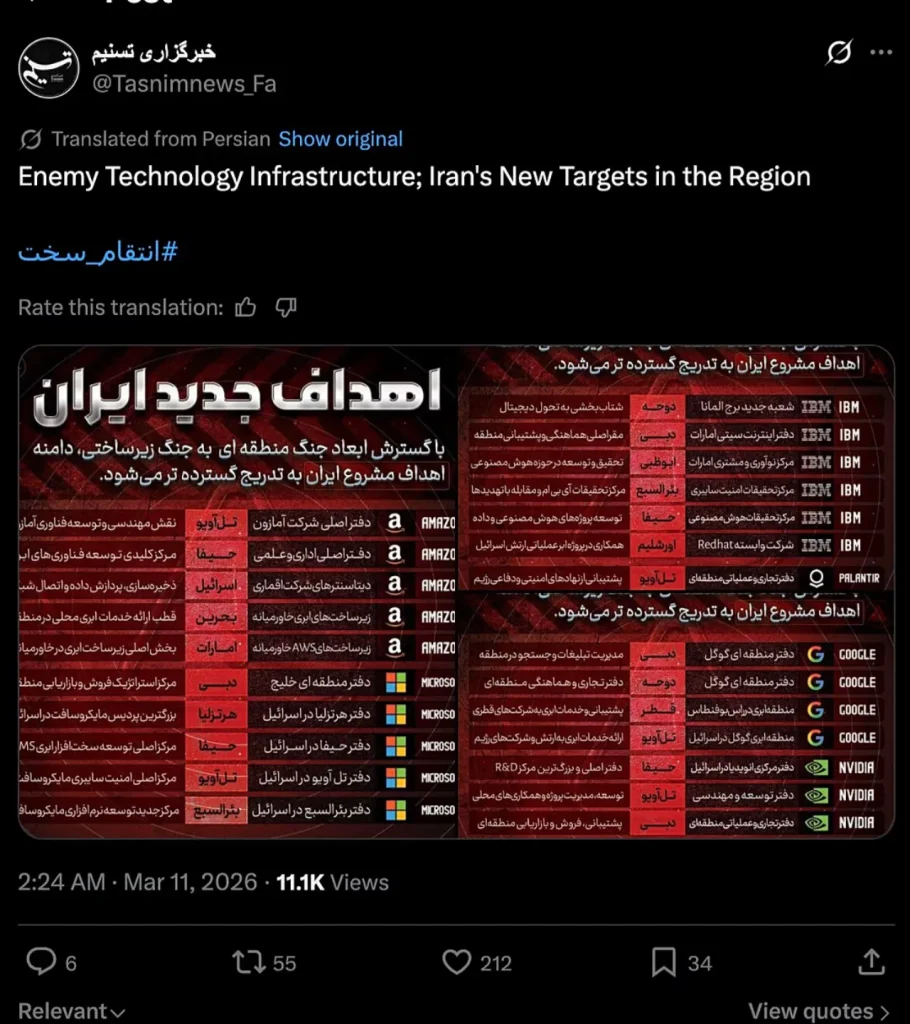
The Tasnim infographic was not a bombing map. It was an activation signal for sleeper cells worldwide. And it was pointing at us — at the flesh that keeps the iron running.
The Fine Print of the End of the World
No sirens. No uniforms. No mobilization order.
Just a push notification on your phone while you make your morning coffee.
I've spent three years working for an IT consultancy with contracts in the tech sector. I wear a company hoodie, designer sneakers, and work remotely from an apartment in central Madrid. They hired me to write code, manage cloud databases and optimize Artificial Intelligence models. They promised me I'd change the world, stock options, pizza Fridays and dental insurance.
Nobody read me the fine print.
On March 12, 2026, the Iranian agency Tasnim News Agency published on the social network X an infographic in red and black. IBM. Amazon. Microsoft. Palantir. Google. Nvidia. With their exact locations. With coordinates in Tel Aviv, Dubai, Doha and Haifa. With a subtitle in Farsi and Arabic that intelligence agencies took less than an hour to translate: 'We know those who feed the machine.'
That morning I understood what I had been for three years without knowing it. Uncle Sam had drafted me. And Iran considered me a military target.
The mistake we all make: we thought the target was the glass buildings. The fortified Data Centers with perimeter defense and mercenaries. How naive. The Tasnim infographic was not a conventional bombing map. It was an activation signal for sleeper cells worldwide. And it was pointing at us. At the flesh that keeps the iron running.
«The keyboard was a weapon of war. I was the ammunition. Nobody told me in the hiring process.»

📚 The Geopolitical «Dog Whistle»
A 'dog whistle' is, in the language of geopolitics and intelligence, a public communication designed to be understood only by a specific group of receivers. The general audience sees apparently informational content. The target audience receives an activation code.
The Tasnim infographic of March 12, 2026 was not a diplomatic communiqué. It was an activation code published openly so that Axis of Resistance sleeper cells worldwide knew exactly which companies and which employee profiles constituted 'authorized targets'.
🎯 Mechanism 1: The public list is the target map
🔍 Mechanism 2: LinkedIn profiles are the GPS points
⚡ Mechanism 3: Local cells are the executors
🔒 Key advantage: Bypasses all conventional security response protocols
ACT 1: The Dog Whistle and the Coffee That Went Cold
I opened X with my first morning coffee. The notification was from a cybersecurity analysis account I follow: '⚠️ Tasnim publishes infographic classifying American tech infrastructure as military targets. Hezbollah Telegram channels react in real time.' The coffee went cold in my hand.
Not because I didn't know the world was tense. On February 28, 2026, the US and Israel had launched Operation Roaring Lion and Operation Epic Fury — one of the largest joint military offensives in recent history, with documented strikes against Tehran, Isfahan, Qom, Karaj and Kermanshah, confirmed by CENTCOM and the Israel Defense Forces. I had followed it in the news with that comforting feeling that it was happening 'far away'.
Now the infographic was telling me that 'far away' was an illusion. The complete Tasnim list named as 'enemy technological infrastructure': Amazon Web Services (centers in Bahrain), Microsoft Azure (centers in Tel Aviv and Dubai), IBM (contracts with IDF), Palantir (data analysis for military targeting), Google Cloud (Doha), Nvidia (GPU supplier for defense AI systems). With locations. With references to specific contracts.
«From 'corporate headquarters' to 'mobile target network' — the narrative shift happened in less than two hours.»
Cybersecurity analysts noticed something beyond the list itself: the file metadata, the publication time, and the amplification pattern in encrypted Telegram channels linked to Hezbollah and the Iranian Revolutionary Guard. It was not a press release for Western journalists. It was a coded signal for cells that had been waiting months for instructions.
That morning, the company's Slack channel filled with messages deleted within five minutes of being sent. Human Resources sent a generic email about 'staying calm and continuing to work remotely'. Nobody was calm. And working remotely, we all discovered simultaneously, meant bringing the target into your own living room.
ACT 2: You Sold Yourself Very Cheap
This is where many of my colleagues convinced themselves they were safe. 'I don't work directly for Palantir.' 'My company is a Spanish consultancy, I don't have Pentagon contracts.' 'I just manage databases. I'm not a strategic asset.'
Wrong. Wrong. Wrong.
Under the new Iranian doctrine — documented in the analysis of Tasnim's communication and the subsequent manifesto of the Handala group — any cog in the machine is part of the enemy army. It doesn't matter if you're a direct employee or six levels deep in subcontracting. It doesn't matter if your company is headquartered in Madrid or Bangalore. What matters is whether your work keeps the infrastructure operational that the Pentagon, IDF or defense contractors use for their operations.
And here's the most obscene insult of all this: they drafted you into a war without telling you. The company promised you stock options and dental insurance. The consultancy sold you 'exciting projects in cutting-edge cloud environments'. Uncle Sam — through a chain of subcontracting you don't even know all the links of — enlisted you in his technological army for €35,000 a year. No combat bonus. No risk coverage. No conscription letter.
📊 Expected vs. Reality of the Benefits Package
| 🌟 Job Offer Promise | 💀 Reality of March 2026 |
|---|---|
| 🏓 Office ping-pong table | 🔍 Checking under your car before going to the supermarket |
| 📈 Rising stock options | ⚰️ Life insurance that excludes 'international terrorism assassinations' |
| 🏠 Flexible hybrid work | 🛡️ Hiding your IP and praying that the delivery driver is really from the delivery service |
| 🦷 Full dental insurance | 🤫 PDF manual 'What to do in an active shooter situation' |
| 🌍 Work from anywhere in the world | 🌍 The whole world is the front line |
📚 The Iranian Doctrine of «Expanded Targets»
In modern warfare, firepower no longer resides solely in the soldiers who pull the trigger. It resides in the data and AI infrastructure that identifies targets, calculates trajectories, manages logistics and processes real-time reconnaissance. That infrastructure is operated by civilians with IT contracts.
The Iranian doctrine argues that attacking physical systems (servers, Data Centers) is inefficient: they are armored and have continuity plans. But the humans who maintain them have neither armor nor redundancy. They are single points of failure — and they can be terrorized until they voluntarily abandon their posts.
The 'corporate desertion' is the civilian version of military desertion. And it is perfectly legal. No court martial. No treason charges. Just an email to Human Resources and the loss of pending benefits.
ACT 3: The Dubai Mirage and the Escape That Doesn't Exist
While I stared at my computer screen in Madrid trying to decide what to do, in Dubai Internet City thousands of people had already made their decision. Suitcases came out of apartments in the middle of the night. 'Immediate resignation' emails fired to tech companies' HR servers before dawn. Emirates flights to Europe and the US filled within hours.
On social networks circulated photos of what nobody would have believed possible a week earlier: Jumeirah Beach empty. Dubai Mall closed. Camels walking along the Promenade where tourists used to take selfies with the skyscrapers. Dubai — the city that sold itself to the world as the 21st-century tech hub — had become a ghost city in less than two weeks.
But the fatal mistake of those who fled was believing they had escaped.
Landing in Frankfurt or Madrid changes nothing. The sleeper cells activated by Tasnim's dog whistle are not in the Middle East. They have been infiltrated in Europe and North America for years. The Emirates flight didn't take you out of the war zone. It just changed the postal code where your name appears on the target list.
ACT 4: «Delete Me from the Org Chart IMMEDIATELY!»
📸 The Screenshot That Says It All
A Strategy VP, publication from March 10, 2026 — 48 hours before the Tasnim infographic. Smiling. In a suit. Next to representatives of the Israeli Ministry of Defense. Caption: 'Proud to announce our collaboration to modernize defense intelligence with next-generation AI. 🇮🇱 #Innovation #AI #Defense'. That post was deleted on March 12 at 11:23 AM. Seventeen minutes after the Tasnim infographic went viral.
The same VPs and Directors who yesterday bragged on LinkedIn about their Pentagon and IDF contracts were today screaming hysterically through their companies' virtual corridors. Direct orders to the IT department: 'Delete my face, my name and my history from the company website, from GitHub and all public repositories. RIGHT NOW!' They no longer fear hypersonic missiles. They fear the lone wolf with a knife in the garage of their mansion in Atherton, California.
The message was unequivocal: it doesn't matter how far you are from the battlefield. It doesn't matter if your company has 'only' an indirect connection with the Israeli defense technology ecosystem. The Iranian chain of responsibility has no distance limits or subcontracting level limits.
ACT 5: Your CV is Your Death Sentence
And we arrive at the most lethal mistake of all. The natural instinct when your company becomes a war target is to look for another company. Update the CV. Post on LinkedIn that you're 'open to new opportunities'. Send mass applications on InfoJobs, Indeed, Glassdoor.
It is exactly what Iran wants you to do.
The OSINT trap: Open Source Intelligence is no longer just the domain of investigative journalists or government intelligence agencies. The same groups that published the Tasnim infographic are systematically scraping LinkedIn, GitHub, Stack Overflow and all job boards in real time. They are not looking for candidates to hire. They are looking for profiles that confirm identity, role in the tech-defense ecosystem, physical location and contact data.
The hunter hunted. The same Big Data technology we use to personalize advertisements is now used to build hunting lists. Every LinkedIn post describing your technical role, every GitHub repository with your name, every profile photo — all feeds a database you can never escape. And the worst irony: the more you try to flee, the more data you leave for them to find you.
And Now, What?
I've been indoors for three days. The company-logo backpack has been in the closet for those same three days. The work laptop is turned off in a drawer. I've disabled LinkedIn notifications. I've set my GitHub profile to private.
I don't know if it helps. My name is already in too many places. What I do know is that nobody — not my company, not my government, not the Pentagon whose contracts indirectly financed my salary — informed me that by signing that IT contract I was being recruited for the strangest war of the 21st century. The war where the enemy doesn't need you dead. It just needs you to be afraid.
And I am afraid. But what scares me most is not the Tasnim infographic. It's the question that keeps spinning in my head since I saw that notification on March 12: And now what?
«The keyboard was a weapon of war. I was the ammunition. Nobody told me in the hiring process.»
Institutional Management · +1M AUM
Talent exodus from Palantir, Google and Amazon due to geopolitical risk won't show up in next quarter's earnings. It will show up first in alternative data: LinkedIn employment changes, code repository activity metrics, relocation contract cancellations. Our algorithmic systems track these signals before the market prices them in.
📋 Verified Sources
All claims in this article are backed by verified primary sources, organized by topic.
| Topic | Source | Summary |
|---|---|---|
| Geopolitics & Middle East Conflict | Público | Iran seeks to leverage its weakened Axis of Resistance factions to expand the war regionally and force negotiations after the US and Israel offensives. |
| Aquí Madrid | Intelligence analysis on 'Operation Epic Fury' detailing the transition toward AI-controlled conflicts and debunking the alleged direction of the attack by the Grok 4 model. | |
| Critical Corporate Cyberattacks (Stryker Case) | Safestate | Pro-Iranian hacktivist group Handala executed a destructive wiper attack that massively erased data and paralyzed Stryker's operations across 79 countries. |
| 7ai.com | Technical and strategic analysis exposing the key actions and vulnerabilities that security teams must address following the destructive attack on Stryker's systems. | |
| Forbes | Stryker's technological disruption highlights for business leaders that recovery speed and business continuity are critical metrics for this type of incident. | |
| eSecurityPlanet | Iran-linked hacktivists claim responsibility for globally disabling Stryker's cloud infrastructure and wiping corporate devices. | |
| Industrial Cyber | Middle East tensions impact global healthcare after the Iran-attributed cyberattack that took down the internal services of medical giant Stryker. | |
| AI Technology Smuggling to China | Review of AI Law | U.S. federal agencies dismantled 'Operation Gatekeeper', a sophisticated network that smuggled advanced AI technology and infrastructure to China. |
| Arnold & Porter | The DOJ prosecuted those responsible for sending AI chips to China, treating export control evasion as national security offenses. | |
| Bank Info Security | U.S. prosecutors charged a criminal network for smuggling $160 million in restricted Nvidia chips to China using falsified labels and shipping documents. | |
| Big Tech Infrastructure Threats | Gente OPA | Iran launched a direct threat by including nearly 30 facilities from Amazon, Microsoft, and Google on a list of potential targets in the region. |
| Diario Popular | Iran formally designated Amazon, Google, and Microsoft offices and data centers as 'enemy technological infrastructure' for providing military support. |