
The Price of the Smoke
Consequences of the AI Blackout: talent, capital and the implosion of digital hegemony
Talent flees, capital repatriates, and chip orders are cancelled simultaneously. Oracle loses the civil Gulf but wins the war economy contract. The smoke hegemony dissipates when the boiler stops feeding the machine.
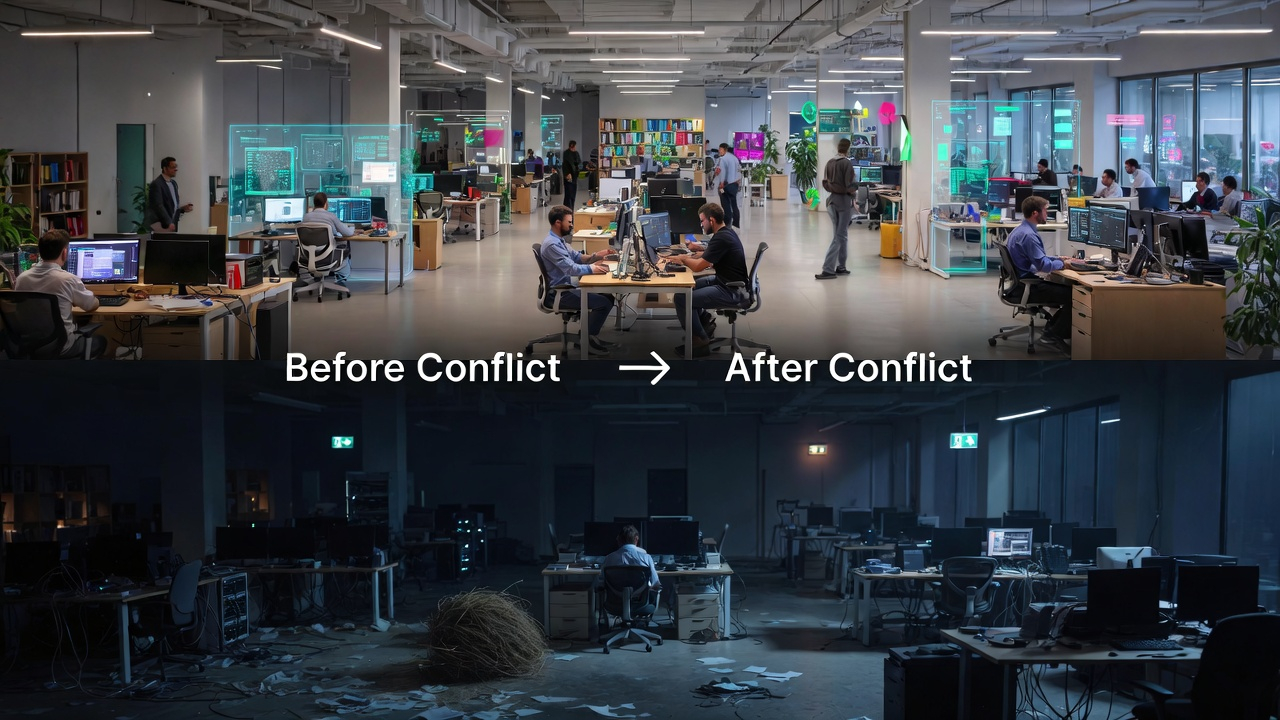
When the Smoke Clears
In the first part we documented the physical mechanism: how the Ormuz blockade interrupts the dependency chain that keeps global AI running. We identified the three vectors of collapse: the geophysical switch, thermodynamic asymmetry, and the silicon hostage.
But physicists know that the real damage from an explosion is not caused by the direct pressure waves. It's caused by what comes after: the vacuum that fills the air when the wave passes. In economics, that vacuum is called confidence flight. This second part analyzes what happens after the first impact: Dubai's talent exodus, the collapse of chip orders, Oracle's contradictory fate, and the question nobody in Silicon Valley wants to answer publicly: who pays the price when the smoke hegemony clears?
«Talent, capital and confidence are the low entropy of the technological system. When geography becomes hostile, that negative entropy escapes without possibility of immediate recovery.»
📚 Negative Entropy in Economic Systems
In thermodynamics, negative entropy is the measure of order in a system. Living systems and economic systems maintain their complexity because they invest energy in creating and maintaining order. A tech hub like Dubai is a low-entropy system: concentrated specialized talent, complex infrastructure, trust networks built over years.
🧠 Talent: The most fragile low entropy — leaves with a plane ticket
💰 Capital: The most quantitatively significant low entropy — redirected to defense systems
🤝 Confidence: The hardest low entropy to rebuild — disappears in seconds
ACT VI: The Negative Entropy Escape
§1 — Dubai: The Oasis Built on the Promise of Security
Dubai's success as a global tech hub depends on one single variable: the perception of security. Not actual security — perception. The AI engineers who chose Dubai did so for something unique: first-world quality of life, zero taxes, global labor market, and an 'oasis of order' in a turbulent region. That perception doesn't require Dubai to be directly attacked. It only requires that the certainty that Dubai can be attacked installs itself in the ecosystem's collective consciousness.
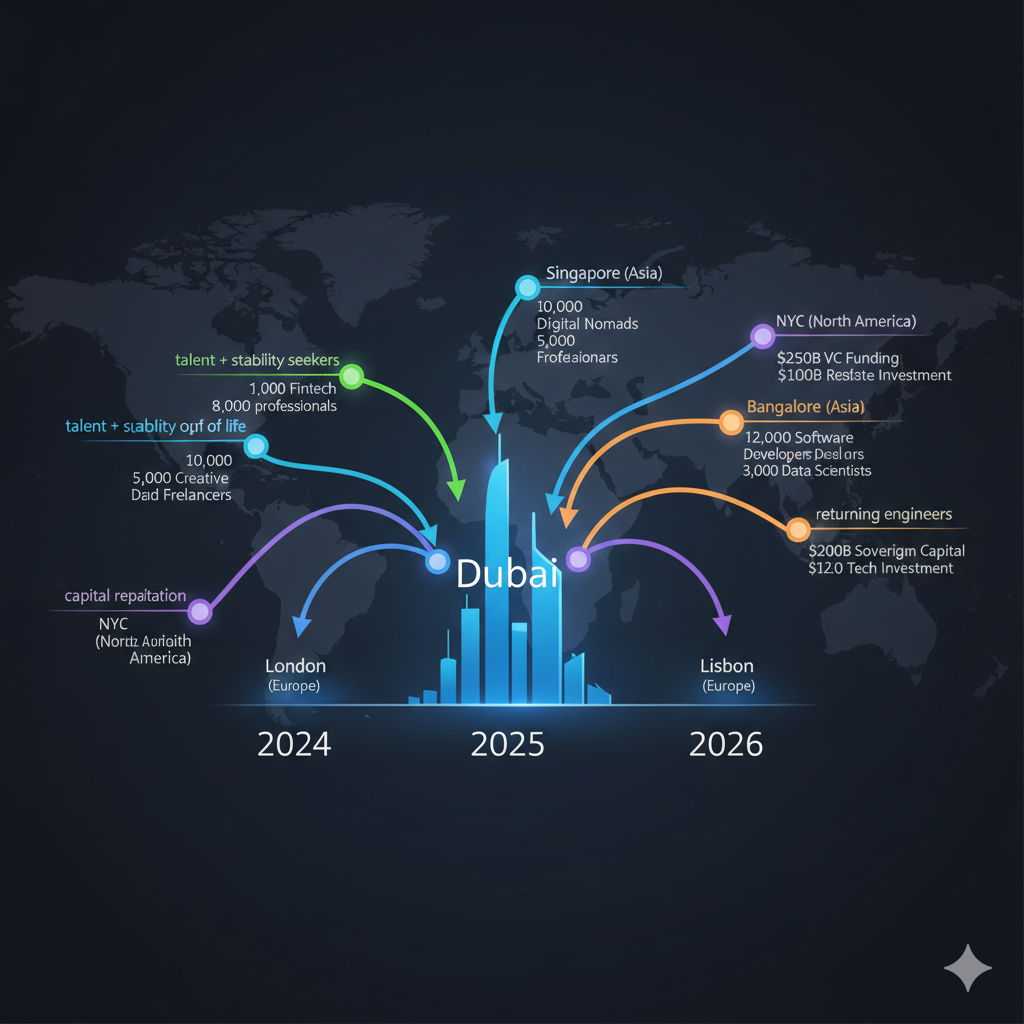
«Dubai's network effect reverses at the first missile. Talent doesn't flee from an ideology — it flees from the interruption of the life supply chain: water, energy, security.»
§3 — Sovereign Capital Repatriation
UAE sovereign funds (Mubadala) and Qatar (QIA) are collectively the largest LPs in Silicon Valley venture capital funds. That money doesn't reach startups directly — but it funds the funds that invest in them. Faced with armed conflict on their territory, these funds don't 'politely pause' their commitments. They freeze them, and redirect that capital toward: covering national budget fiscal holes, and acquiring air defense systems and emergency infrastructure. The money that yesterday funded an AI startup in San Francisco today funds a Patriot missile battery in Abu Dhabi.
📚 Gulf Sovereign Funds as LPs of the Global AI System
Gulf sovereign funds are investment vehicles capitalized with surplus oil and gas revenues. Mubadala (UAE) manages over $300B; the Qatar Investment Authority (QIA) over $450B. Their impact on the AI ecosystem is not just as direct investors — it's as LPs of Silicon Valley's most influential venture capital funds.
🇦🇪 Mubadala (UAE): >$300B AUM — LP in a16z, SoftBank, KKR and more
🇶🇦 QIA (Qatar): >$450B AUM — LP in Sequoia, Lightspeed and more
⚡ Impact: Gulf withdrawal = 80% of AI startup funding collapses
ACT VII: Cost Asymmetry — The Fallacy of Precision Strikes
§1 — The Mathematics of Asymmetric Conflict
| Iranian Weapon | Cost | Target / Damage | Ratio |
|---|---|---|---|
| Magnetic sea mine | $5,000 |
Ormuz blockade (20M bbl/day off market) |
1:∞ economic |
| Shahed-136 drone | $20,000 |
AWS datacenter in UAE ($2B) — inference node offline |
1:100,000 |
| Shahed-136 drone | $20,000 |
Desalination plant ($500M) + operational cascade |
1:25,000 |
| ⚠️ Patriot missile (defense) | $3-4M |
Incoming drone $20k — US pays 200x more per interception |
200:1 (defense loses) |
§2 — The Fracture of the 'Security Umbrella'
US hegemony in the Middle East worked under an implicit contract: Gulf countries tolerated US political and financial dominance in exchange for the 'security umbrella'. That contract has a clause that was never written: 'except when the political costs are too high'. When the UAE and Qatar understand the umbrella doesn't cover the Strait, the contract breaks. The search for alternatives is not ideological: it's rational.
📚 Oracle — Between the Bunker and the Stranded Asset
Oracle is neither a pure hyperscaler nor an AI startup. It is the database of the Western financial and governmental system: banks that cannot turn off Oracle because Oracle stores their customer data, governments that cannot migrate because Oracle manages their payroll, taxation and logistics. Its Gulf expansion followed hyperscaler growth logic. The conflict bifurcation simultaneously makes it a loser (Gulf civil market) and a winner (Western military contract).
ACT VIII: The Sudden Stop and the Fate of Silicon
§1 — Oracle: The Case Study of Bifurcation
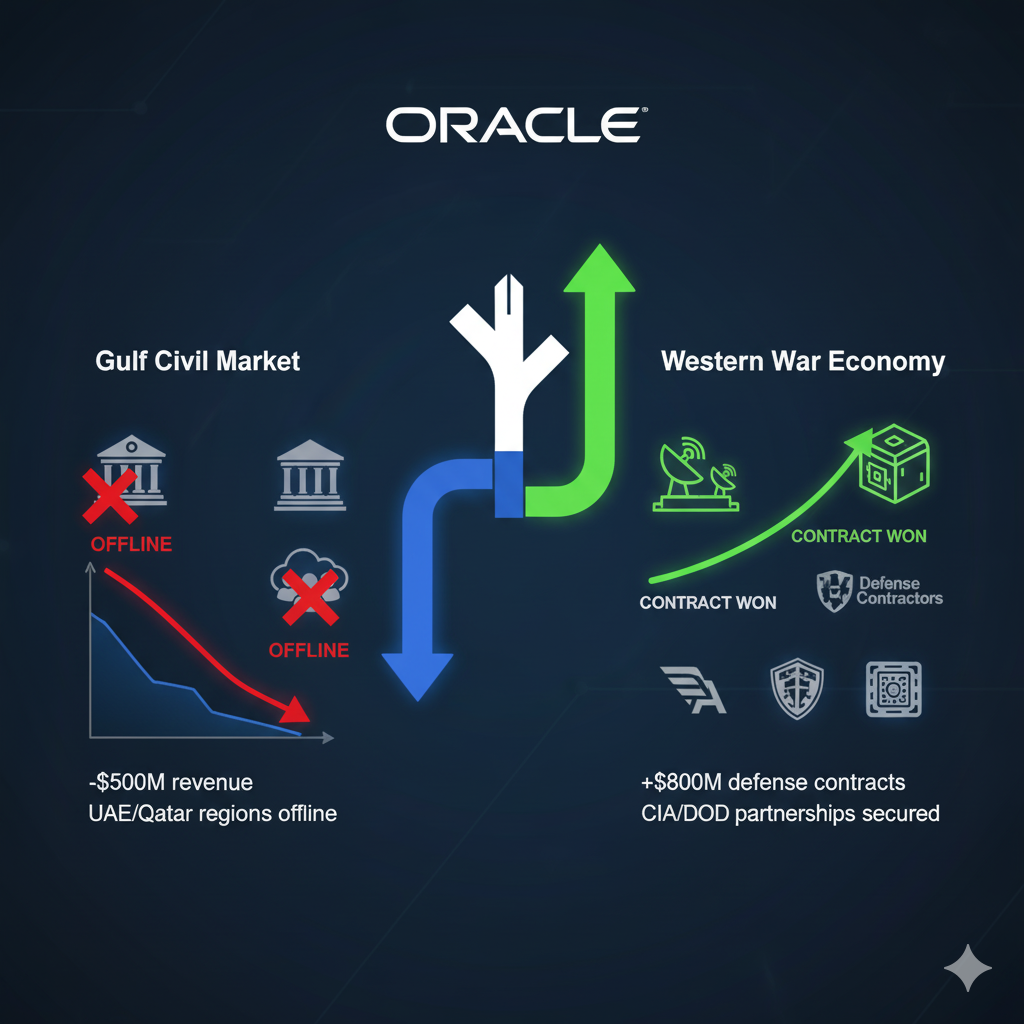
Immediate negative impact (months 1-12): Cloud Regions in Dubai and Abu Dhabi offline, SLA breaches with regional governments and banks, physical loss of CAPEX assets. Structural positive impact (year 2+): Oracle is the database of the CIA, Mossad and US Department of Defense. In a wartime scenario, edge military computing and ultra-secure databases for military logistics become indispensable. Oracle loses the Gulf civil market — and becomes the pillar of Western war economy.
§2 — The Death of Global Chip Demand
Three simultaneous collapse vectors: (1) Frozen capital: Gulf sovereign funds redirected to defense → 80% of AI startups without funding → Nvidia orders cancelled. (2) Prohibitive energy cost: with oil at $150 and gas through the roof, ROI of new GPUs becomes negative → no new CAPEX. (3) Inventory panic: Nvidia goes from 'one-year waiting list' to full warehouses → H100 secondary market collapses → shadow banking collateral evaporates.
«The semiconductor market was a CAPEX bubble sustained by cheap energy and printed dollars with Gulf sovereign backing.»
ACT VIII: The 'Stargate UAE' Paradigm — The Bet That Destroyed the Narrative
§2 — Shahed Drones as Anti-Cognitive Weapons
The First Military Silicon in History
Shahed-136 drones impacting AWS datacenters in the Emirates and Bahrain: the first time silicon is a direct military target in history.
It's not an attack on 'military capability'. It's an attack on the cognitive nervous system of the West. The AI that directs military logistics, models negotiation scenarios, processes intelligence signals in real time: all offline. In seconds. Welcome to 21st-century cognitive warfare.
The 'Stargate UAE' project — a 5GW datacenter planned in the UAE with investment from OpenAI, SoftBank and Gulf sovereign capital — represents the apex of the dematerialization illusion. The Microsoft-G42 deal of April 2024 was the prelude. The U.S. explicitly placed, under White House supervision, its most advanced technology in a geographic zone that is 35 kilometers from Iranian drone range.
ACT IX: The Involuntary Demolition — The System Closes
The U.S., by failing to understand the thermodynamics of conflict and believing in its own narrative of technological superiority, facilitated the destruction of the pillars of its future economy. The cost of maintaining inference in a wartime world exceeds the productivity AI can return. The world's most advanced hardware is trapped in the desert. The best engineers have taken the first available flight. Sovereign capital funds missiles, not GPUs. And confidence in the 'global cloud' has evaporated.
The Three Consequences
The Entropy Escape
Talent and capital don't return just because the conflict ends. The ecosystem rebuilds in another city.
The Oracle Verdict
Oracle loses the Gulf civil market. It becomes the pillar of Western war economy.
The Thermodynamic Closure
The cost of inference exceeds its value. AI doesn't die from lack of intelligence — it dies from energy starvation.
Company Impact Matrix
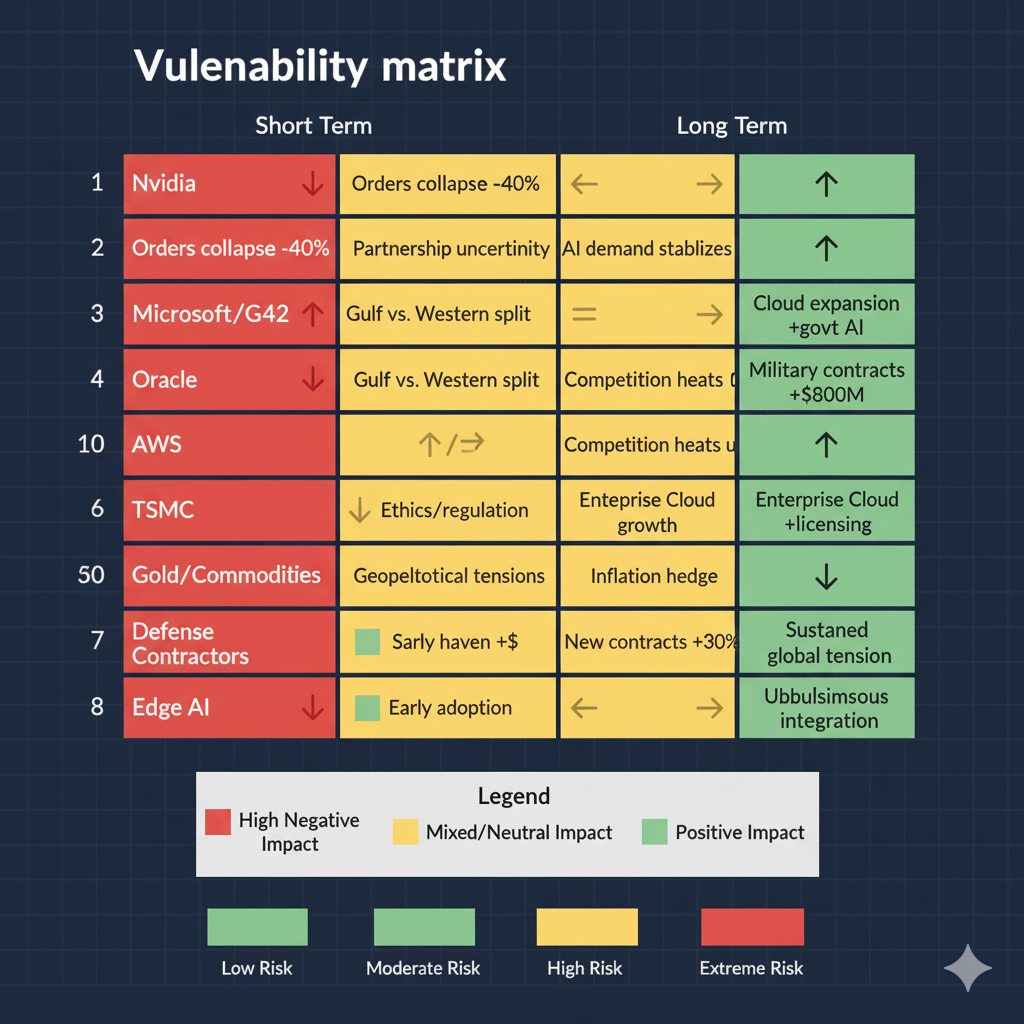
| Company | Short Term | Long Term | Verdict |
|---|---|---|---|
| Nvidia | Gulf orders collapse → -40% stock |
Military/Edge demand partially compensates |
🔴 Moderate bearish |
| Microsoft/G42 | $1.5B loss, Stargate UAE halted |
Withdraws assets to safe geographies |
🔴 Strategic loss |
| Oracle | Gulf Cloud offline, SLA breaches, stranded CAPEX |
Military/defense contracts compensate |
🟡 civil↓ military↑ |
| AWS/Amazon | UAE/Bahrain zones offline |
Geographic diversification accelerates |
🟡 Reorganization |
| OpenAI/Altman | Stargate UAE cancelled, funds frozen |
US/Europe projects delayed 3-5 years |
🔴 Massive delay |
| TSMC/Taiwan | Chip demand collapses |
Strategic relevance under review |
🔴 Systemic risk |
| Gold / Commodities | Immediate safe-haven rally |
Sustained in prolonged conflict |
🟢 Sustained bullish |
| Defense (RTX, LMT) | Immediate orders |
Long-term government contracts |
🟢 Sustained bullish |
| Edge AI / ASIC | Local demand acceleration |
Dominates resilient inference market |
🟢 Structural bullish |
The Price of the Smoke
US digital hegemony didn't die because Iran was more powerful. It died because the hegemony was built on a physical illusion: that bits could govern atoms without controlling the geography where atoms reside. The antifragile investor who understands this dynamic doesn't have to predict the timing of the collapse. They have to understand the structural direction: decentralized energy, continental infrastructure, Edge AI, physical assets.
«The war against Iran is not fought in Tehran's bunkers. It is fought in Nvidia's income statement and in Oracle's server latency. In the end, the smoke of hegemony dissipates when the boiler stops feeding the machine.»
Institutional Management · +1M AUM
Oracle loses the civil Gulf but wins the war economy contract. Nvidia collapses in orders but the defense segment compensates. Separating these vectors precisely — and converting them into actionable signals — is what geopolitical risk monitoring algorithmic systems do.