
The Thermodynamic Collapse of Hegemony
Why the attack on Hormuz and the Gulf is not a regional crisis but the systemic shutdown of Global Inference
The Strait of Hormuz is not a 20th-century oil problem. It is the master switch of the 21st-century inference economy. And the U.S. built its thermodynamic boiler in the backyard of its most asymmetric adversary.
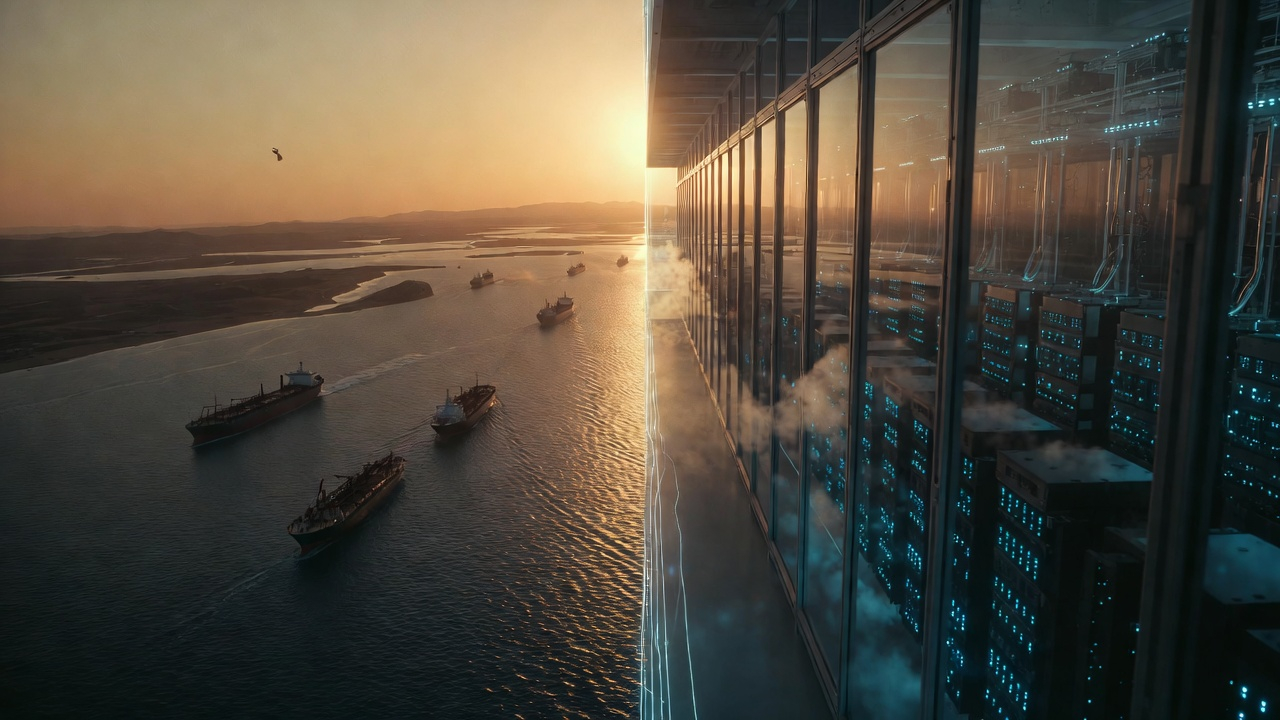
The Map Nobody Draws
Somewhere between Dubai and Abu Dhabi, inside a maximally cooled data center in the middle of the desert, a cluster of 50,000 Nvidia H100 GPUs is processing AI queries from millions of users right now. That cluster consumes the energy of a mid-sized city. That energy comes from Qatar's natural gas flowing through the Strait of Hormuz. And on the other side of the Strait, 35 kilometers away in a straight line, Iran has batteries of Shahed-136 drones.
This is not a regional energy crisis. It is the existential vulnerability of the AI era. In our previous article we established that AI is not 'silicon magic': it is a thermal machine that transforms energy into probability — into inference. Now, that analysis needs a second act. Because the same machine we identified as subject to diminishing returns and the scaling law wall is operating on the most dangerous geopolitical board of the century.
«Training a model is a capital expense; inference is a survival expense.» When the boiler shuts down, the machine doesn't process — it stops.
📚 The Strait of Hormuz as an AI Variable
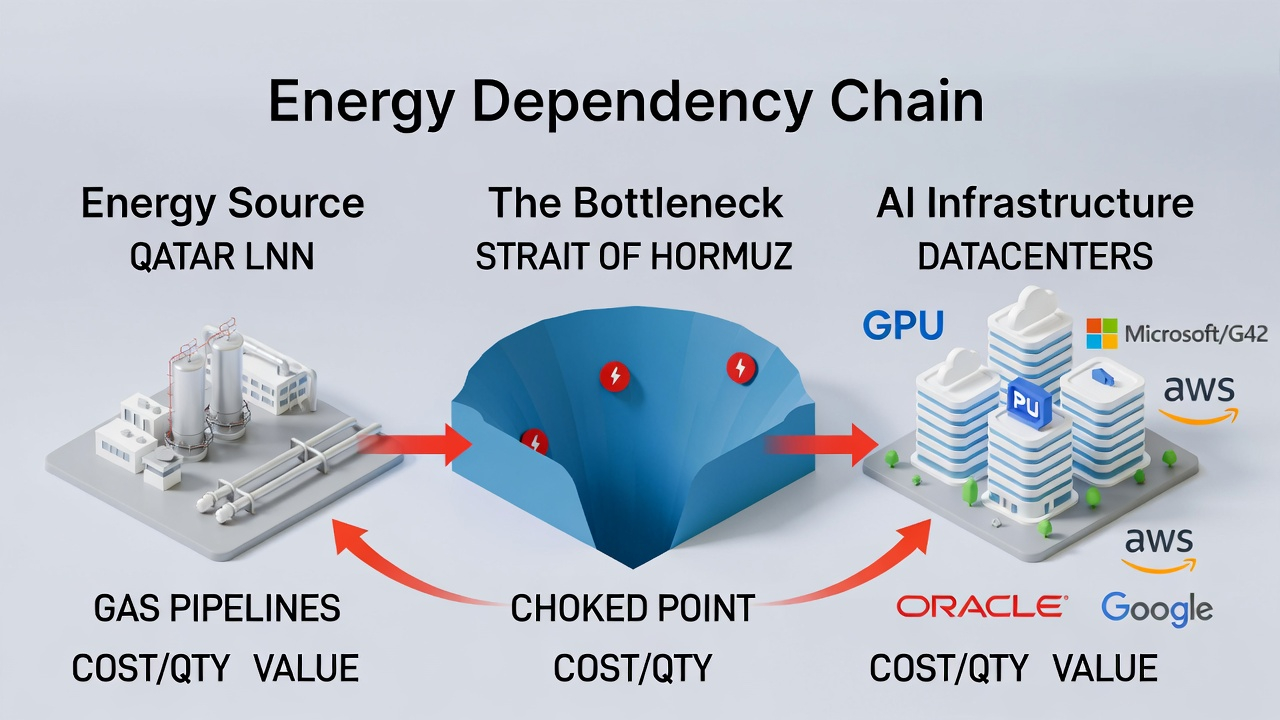
The Strait of Hormuz is not just an oil passage. It is the geographic point where three critical dependency chains for the global AI economy converge: Qatar's LNG feeding hyperscaler power plants in the UAE, Gulf sovereign funds (Mubadala, QIA) as the main LPs of Silicon Valley venture capital funds, and the physical infrastructure of Microsoft, Oracle, AWS and Google — billions in data centers in Dubai, Abu Dhabi and Qatar.
🔥 Dependency 1: Energy for datacenters (Qatar LNG → UAE electricity)
💰 Dependency 2: Expansion capital (sovereign funds → venture capital → chips)
🏗️ Dependency 3: Physical infrastructure (Microsoft, Oracle, AWS, Google in the Gulf)
ACT I: The Return to Atoms
§1 — The Illusion of Dematerialization
The West built, over the past three decades, a seductive narrative: the economy was dematerializing. Value no longer resided in factories, oil wells or copper mines. It resided in algorithms, data and digital platforms. AI was the crowning of that narrative. If AI could predict the market, diagnose diseases, design molecules — all in microseconds, from a server in Virginia — then dependence on unstable geographies was an engineering problem, not a structural limitation.
It was an accounting illusion. Qatar's LNG cools AWS servers in Dubai. UAE oil powers Oracle's emergency generators in Abu Dhabi. The engineers programming AI models live in Dubai because the emirate's 'order' makes it possible. Every 'bit' of cloud inference has an equivalent in 'atoms' that someone extracts, transports and converts into electricity — and those atoms pass through a 54-kilometer-wide geographic point: the Strait of Hormuz.
«If AI is thermodynamic, the Gulf is its boiler.»
§2 — The Risk Accounting the Market Ignores
A scenario of Strait of Hormuz blockade combined with attacks on UAE and Qatar energy infrastructure would not be a 'regional crisis'. It would be a systemic Black Swan event. Immediate financial market consequences would include: Brent and WTI at $120-150 USD, VIX exceeding 40-50 points, S&P 500 correction of 10-20% in weeks, EURUSD falling toward parity, and gold seeking all-time highs above $2,500-2,700.
| Asset | Impact | Magnitude |
|---|---|---|
| 🛢️ Oil (Brent/WTI) | 🔴 Violent rise |
$120-150 USD — 20M bbl/day off market |
| 🔥 Natural Gas (TTF/JKM) | 🔴 Historic rise |
+300-500% — Qatar world's largest LNG exporter |
| 📊 VIX | 🔴 Extreme spike |
>40-50 points — unresolvable short-term uncertainty |
| 📉 S&P 500 | 🔴 Sharp correction |
-10-20% in weeks — stagflation + impossible Fed dilemma |
| 💱 EURUSD | 🟡 Initial drop |
Toward parity (1.00) — dollar flight; structural erosion long-term |
| 🥇 Gold | 🟢 Safe-haven rise |
$2,500-2,700+ — only asset without counterparty risk |
| 💻 Tech Stocks (Gulf-exposed) | 🔴 CAPEX collapse |
-30-50% — stranded assets + frozen demand |
📚 Inference vs. Training in a Crisis Context
Training: the process of creating an AI model. Requires enormous amounts of compute for weeks or months — it's a one-time capital expense. Inference: the process of using an already-trained model. Happens billions of times daily, globally. Cannot be paused or deferred. Requires constant electricity, continuous cooling and real-time network connectivity.
ACT II: The Inference Wall Under Fire
§1 — The Pivot the Market Forgot
The official AI discourse was obsessively fixed on training: who has more GPUs? But the world already made the pivot analysts were slow to see: the era of massive training ended. The era of inference began. A doctor's ChatGPT in São Paulo, a programmer's Copilot in Bangalore, a financial analyst's Gemini in London — all of that is inference, 24/7/365. And all that inference needs electricity.
§2 — The Geophysical Wall: Beyond the Scaling Law
In our previous article we documented the 'scaling law wall'. Now there's a second, more material and immediate wall: the geophysical wall. It's not that models don't scale efficiently — it's that the energy cost per generated token can become greater than the economic value that token generates. AI doesn't get dumber. It becomes inaccessible. And the economic difference between 'dumb' and 'inaccessible' is, for the investor, exactly zero.
ACT III: The Demand «Sudden Stop»
§1 — The CAPEX in the Line of Fire
Big Tech has invested tens of billions in AI infrastructure in the Gulf. Microsoft: $1.5B in G42 (Abu Dhabi). Oracle: Cloud Regions in Dubai and Abu Dhabi. AWS: Zones in UAE and Bahrain. Google: Data center in Qatar. OpenAI/Altman: 5GW 'Stargate UAE' Project. This CAPEX assumes geopolitical stability. Without stability, it becomes strategic liability.
§2 — Stranded Assets: The Dead Iron of the Desert
A cluster of 50,000 Nvidia H100 GPUs in Dubai cannot simply 'unplug and move' when missiles fall. It's industrial-grade infrastructure: racks weighing tons, integrated liquid cooling systems, zero-latency fiber optic connections. Extracting thousands of servers from a Dubai datacenter under missile threat requires heavy transport, military escort and operational ports or airports. If Hormuz is closed, that hardware is trapped.
«The semiconductor market discovered what it always knew but never wanted to say: it was a CAPEX bubble sustained by cheap energy and printed dollars with Gulf sovereign backing.»
📚 G42 — The Tech Bridge in the Eye of the Hurricane
G42 (Group 42) is not a conventional tech company. It is the executive arm of UAE national intelligence, chaired by Sheikh Tahnoon bin Zayed Al Nahyan — National Security Advisor and brother of the UAE President. The Microsoft-G42 deal of April 2024, directly supervised by the White House, conditioned the $1.5B investment on G42 eliminating all Huawei technology and exclusively adopting US chips and software.
ACT IV: The Asymmetry of Martyrdom
§1 — The Equation the Pentagon Won't Acknowledge
An Iranian-made Shahed-136 drone costs approximately $20,000. An AWS inference node in the Emirates is worth around $2 billion. The ratio is 1:100,000. The thermodynamics of conflict play irrevocably in Iran's favor: it is exponentially cheaper to increase entropy (destroy, create chaos) than to maintain order (operate AI, sustain hegemony).
The Equation the Pentagon Won't Publish
Shahed-136 drone: $20,000. AWS inference node: $2,000,000,000. Ratio: 1 : 100,000.
The thermodynamics of conflict is not an ideological thesis. It's an economic statement: it's exponentially cheaper to increase entropy (destroy) than to maintain order (operate AI + hegemony). Iran doesn't need to win. It just needs to increase the system's thermal noise.
§2 — The American Miscalculation
The U.S. believed precision strikes could 'solve' the Iranian problem. But AI requires three things to function: absolute electrical frequency stability, continuous cooling and zero-latency fiber optic connectivity. Iran only needs one: constant interruptions in any of those three dependencies. No need to directly bomb a datacenter. Just attack the power grid that feeds it or the desalination plant that cools its systems.
ACT V: The Demolition of the 'Silicon Foundations' in the Desert
§1 — Big Tech's Geographic Miscalculation
The Microsoft-G42 deal of April 2024 and OpenAI's 'Stargate UAE' project share a common denominator: the assumption that the U.S. could guarantee the security of that geography. For that deal to work, the U.S. had to be able to protect the Strait of Hormuz. And the U.S. cannot close Hormuz. It never could. By failing to protect the Strait, the U.S. left its most advanced technology as a hostage in an active conflict zone.
§3 — Oracle: From 'Digital Bunker' to 'Stranded Asset'
Oracle sells 'Sovereign Cloud': physical black boxes a government can install on its own territory, maintaining total sovereignty over its data. The problem is that it confuses technological sovereignty with geopolitical sovereignty. Oracle can guarantee UAE data doesn't leave Emirati territory. It cannot guarantee the desalination plant cooling its servers remains operational when Iranian missile batteries interfere. An attack on Oracle in Abu Dhabi doesn't erase data — it destroys confidence in the global cloud.
The Three Vectors of Collapse
The Geophysical Switch
Hormuz is not a 20th-century oil problem. It is the master switch of the 21st-century inference economy.
Thermodynamic Asymmetry
$20k drone vs. $2B datacenter. Entropy always beats order. The attacker pays a fraction of the defender's cost.
The Silicon Hostage
The U.S. put its most advanced technology as hostage in the backyard of its most asymmetric adversary.
Energy Scenarios and Their Impact on AI
| Scenario | Catalyst | AI Energy Cost | US Digital Hegemony |
|---|---|---|---|
🟢 Negotiated peace |
US-Iran diplomacy / nuclear deal |
No change |
Maintains position |
🟡 Chronic tension |
Intermittent attacks without total blockade |
+30-50% |
Gradual erosion |
🔴 Ormuz blockade |
Effective closure (mines + Shahed drones) |
+200-400% |
Accelerated demolition |
The Boiler That Cannot Be Shut Down at Will
The U.S. built the world's tallest digital building. But it chose, consciously or unconsciously, to place that building's boiler in the backyard of its most asymmetric adversary, at the most strategically important geographic bottleneck on the planet. That's not a metaphor. It's the map of Gulf datacenters overlaid with Iranian drone range.
The investor, manager and strategist who understands this doesn't panic or abandon technology. They understand that there is technology that survives without the Gulf (Edge AI, continental infrastructure, chips for military use) and technology that depends on that boiler (Gulf-first hyperscalers, CAPEX in conflict zones, startups funded by Gulf sovereign funds). The second part of this series analyzes what happens when the boiler shuts down.
«The U.S. is not losing the AI war for lack of chips. It's losing it because it built its thermodynamic boiler in the backyard of its most asymmetric adversary.»
Institutional Management · +1M AUM
Ormuz risk isn't monitored with Bloomberg — it's monitored with geopolitical stress indicators that precede disruptions: maritime insurance spreads, out-of-the-money oil options, institutional VIX positioning. Our algorithmic systems track these signals in real time.