
The Resignation Letter
The Silent Collapse of the Outsourced Soldier
Iran doesn't need to destroy the servers to win the tech war. It just needs systems administrators to be afraid enough to stop going to work. And it's working.
ACT 6: The Target on Your Backpack
Today is Thursday. Normally I would go to the office. The backpack is still in the closet. The company logo — discreet, but perfectly legible — is on the outside side pocket. I used to be proud to wear it. Now I wonder if wearing it on the subway is the same as wearing a neon target on my back.
Yesterday at dinner, my partner asked if I should bring the work laptop to the café downstairs to work on the project. I stared at the screen for three seconds longer than it should have taken me to answer. Because what I saw during those three seconds wasn't the laptop. I saw the company logo on the screen. I saw the café terrace. I saw the people walking by. And I wondered, for the first time in my adult life, if one of them had seen the same infographic as I had.
ACT 7: The Geneva Paradox in the Cloud
Honest question for corporate lawyers: Under what category of International Humanitarian Law do I classify? Geneva Convention IV (1949) protects civilians in armed conflicts. It establishes that a civilian loses that protection only if they directly participate in hostilities — that is, if they take up arms, fire, or actively participate in combat operations.
I do none of that. But if my API connects the metadata analysis database that then feeds the facial recognition system the IDF uses to identify targets in precision operations — am I still a civilian under the Geneva Convention? Or am I, as Iran argues, an 'indirect but essential participant' in the hostilities?
The honest answer is that nobody knows. International law in 2026 did not have sufficient jurisprudence to resolve this question. And while war law academics debate at their Hague conferences, sleeper cells have no doubts.
📚 «Corporate Desertion» as a Weapon of War
In a conventional army, if a soldier abandons their post out of fear of the enemy, they commit the crime of desertion. They face a court martial. They can be imprisoned. The State exercises explicit coercion to keep its combatants in position.
In the 21st-century technological army, there is no such coercion. A Senior Cloud Engineer in third-level subcontracting is an 'at-will' employee. If they fear dying at work, they can send an email to HR, break their contract, and go home. No charges. No prison. No institutional dishonor. At most, they lose their bonus and stock options.
The perverse genius of the Iranian strategy: they have hacked the business model of the military-technology complex. They have created the conditions of terror for the adversary's troops to voluntarily desert, without needing to defeat them in combat.
ACT 8: The Silent Collapse
Iran is brilliant in its asymmetry. Hacking NSA servers is almost impossible. Bombing Oracle's Data Center in Virginia is an act of war with devastating consequences for the aggressor. But terrorizing the systems administrators working at home in Madrid, in Cork, in Bangalore, in Seattle — that is incredibly cheap. The cost of publishing an infographic on X is zero. The cost of activating sleeper cells that have been in position for years is the cost of patience. And the return is exponentially greater than any conventional cybersecurity operation.
«Iran doesn't need to destroy the servers. It just needs systems administrators to be afraid enough to stop going to work. And it's working.»
📊 The Silent Collapse Cascade Effect
Terror → Absenteeism
Fear causes IT employees not to go to work either remotely or in person. There is no coercion mechanism to force them back.
Absenteeism → Degradation
Without constant human maintenance, systems degrade. Targeting AI loses quality and produces false positives — the most dangerous thing in an autonomous weapons system.
Degradation → Collapse
Military operators lose confidence in automated systems. The West's technological advantage erodes without a single missile being fired at the servers.
What Oracle executive will send their team to do physical maintenance on a server node in the Middle East knowing they are on a terrorist target list? What insurer will cover Palantir workers' life insurance in the region? How do you keep AI military infrastructure operational if 40% of your civilian engineers go on strike, demand to work remotely from safe countries, or simply resign out of panic?
ACT 9: Mercenaries for Hardware, Meditation for Flesh
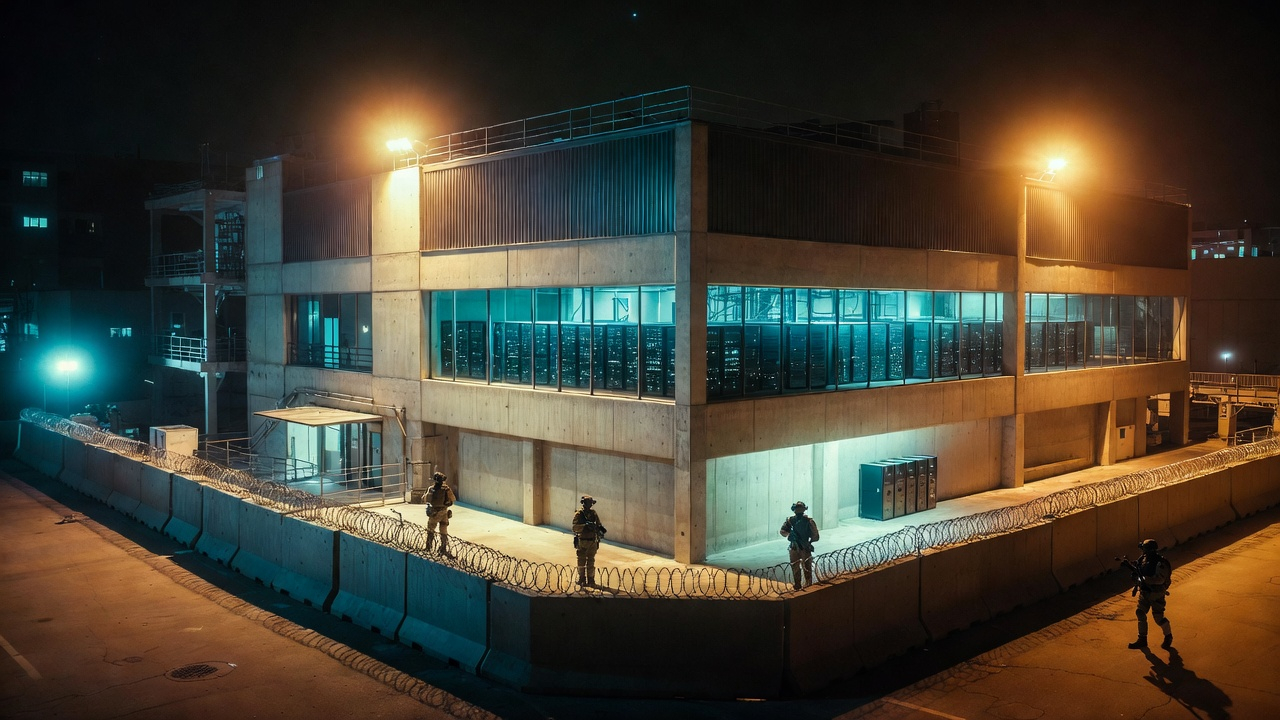
This is where companies show their true value system. Since March 12, 2026, all Big Tech companies have activated reinforced security protocols. The content of those protocols is revealing.
For Data Centers 💰
Private security contractors (ex-Constellis/ex-Blackwater personnel)
Perimeter detection systems and surveillance drones
Seismic sensors and reinforced barbed wire
For Employees 🧘
45-min webinar: 'Personal Resilience in Times of Global Uncertainty'
12-page PDF manual: 'What to do in an active shooter situation'
30 days of Calm meditation app
📊 Big Tech Security Budget Distribution (After Mar-12-2026)
| Category | % of Budget |
|---|---|
~95% 🏰 Fortification and private security for physical Data Centers |
~95% |
~4.9% ⚖️ Law firms to shield against lawsuits from affected employees' families |
~4.9% |
~0.1% 🧘 Psychological support and personal security programs for employees |
~0.1% |
The message those percentages communicate needs no interpretation.
ACT 10: The SEND Button
It's 2:47 in the morning. The monitor illuminates my face in the dark room. The email window is open. The recipient: the consultancy's HR. Subject: 'Voluntary contract termination'. The body of the message is already written.
I'm not asking for a severance package. I'm not going to negotiate compensation. I don't care about losing the three months' notice I technically should give. I don't care about losing the pending benefits. I don't care about being blacklisted in the sector.
My finger is over the mouse. And I hesitate. Not because I want to stay. But because I know it may be useless. My name is already in the LinkedIn download from the night of March 12. My face was on the company website until IT deleted it on the morning of the 13th — but Dark Web scrapers had already indexed it. My GitHub repository, even though it's now private, was public for four years.
Resigning now is like taking off your uniform when the sniper already has you in their sights. The gesture may have moral meaning for you. For them, it changes nothing.
But I hit 'Send' anyway. Because if I don't, I remain an active cog in the machine that someone, somewhere, has decided to destroy. And at least this way, if something happens, let it be for what I've already done. Not for what I consciously do tomorrow.
The Letter Nobody Read
The email is sent at 2:48 in the morning. I receive the automatic read receipt from the HR mail server. On some AWS server — one of those on the Tasnim list, note the irony — my message arrives in a corporate inbox that nobody will read until 9 in the morning.
I wanted to program the future. Everyone's future, the one where Artificial Intelligence solves cancer and optimizes supply chains and makes the world more efficient. They sold me that dream with stock options and dental insurance and the possibility of working from anywhere in the world.
But Uncle Sam outsourced me at a bargain price for World War III, without saying a word. And when Iran published its list, I discovered I had been enlisted in an army that doesn't protect me, for a war nobody officially declares, with an enemy that doesn't distinguish between the General and the database operator who works remotely from their 60-square-meter apartment in Madrid.
«I wanted to program the future. But Uncle Sam outsourced me at bargain price for World War III, and put me on the target list of a shadow army. Today I hit 'Send' on my resignation. Let them configure their damn Cloud themselves. I just want to survive tonight.»
Institutional Management · +1M AUM
The silent collapse of AI infrastructure through terror has no alarms. There is no Bloomberg headline saying '40% of cloud engineers didn't show up to work today'. There are alternative data that capture it: LinkedIn employment changes, code repository activity metrics, relocation contract cancellation patterns. Our systems trade them in real time.