
The Hormuz Theorem
Part II — The Collapse of the Invisible Empire
When 10 mines, a communiqué and a bond chart destroyed the petrodollar
You don't need a nuclear bomb to demolish an Empire. All you need is ten sea mines, an official communiqué and the gaze of a fund manager staring at a bond curve bleeding toward 5%. In the second part of this story, the journalist who saw the Hormuz regulation coming from a Tehran garden takes us from Istanbul to Dubai, and from the scariest bond market of the decade to the Nowruz epilogue.
The Collapse Textbooks Don't Teach
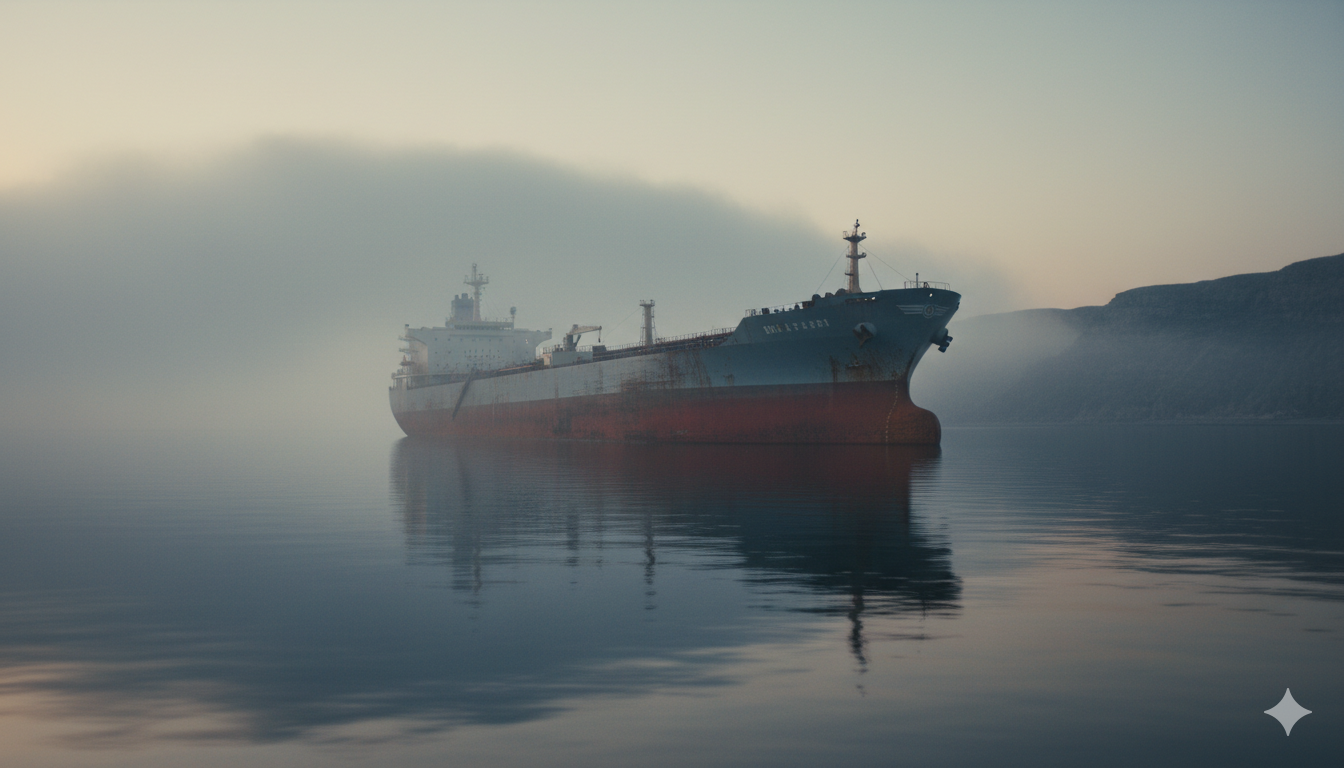
There is a way to collapse an Empire that history textbooks don't teach. It is not a pitched battle. It is not a street revolution. It is not even a nuclear crisis. It is a combination of three much more banal and much more lethal things: a bond chart moving in the wrong direction, a port where ships no longer sail, and a tech executive sending his tenth email of the day from Dubai airport at three in the morning.
We were in the second week of March 2026, and the Empire was collapsing. Not dramatically. Silently. As empires always collapse when the real process has been underway for years and only then, all at once, becomes visible to everyone.
I saw it coming from a garden in Tehran. Now I was living it across five different cities in seven days.
🎬 ACT 5 — The War on a Spreadsheet · Istanbul, February 28, 2026
The Economic Demolition
The most important war of the 21st century is not being fought in the desert. It is being fought on Pentagon spreadsheets. And it is losing.
My contact in Istanbul — let's call him James, a hedge fund manager from a firm that prefers anonymity — called me via encrypted video from a café in the Beyoğlu neighborhood. It was February 28. Open hostilities between the US and Iran had been officially declared barely two days earlier. James had the face of someone who has slept four hours in forty-eight, but the eyes of someone who has been waiting for this for years.
 James, Istanbul, February 28. 'How much does it cost to shoot down a Shahed drone?' The question that turned a military crisis into a Pentagon balance sheet crisis.
«How much does it cost to shoot down a Shahed drone? I don't know, two million dollars in an SM-2 missile? Exactly. And the drone cost €3,000 in Chinese components assembled in a cave. Now multiply that by the hundred intercepts of last week. And by those yet to come.»
— James, gestor de fondos de cobertura, Estambul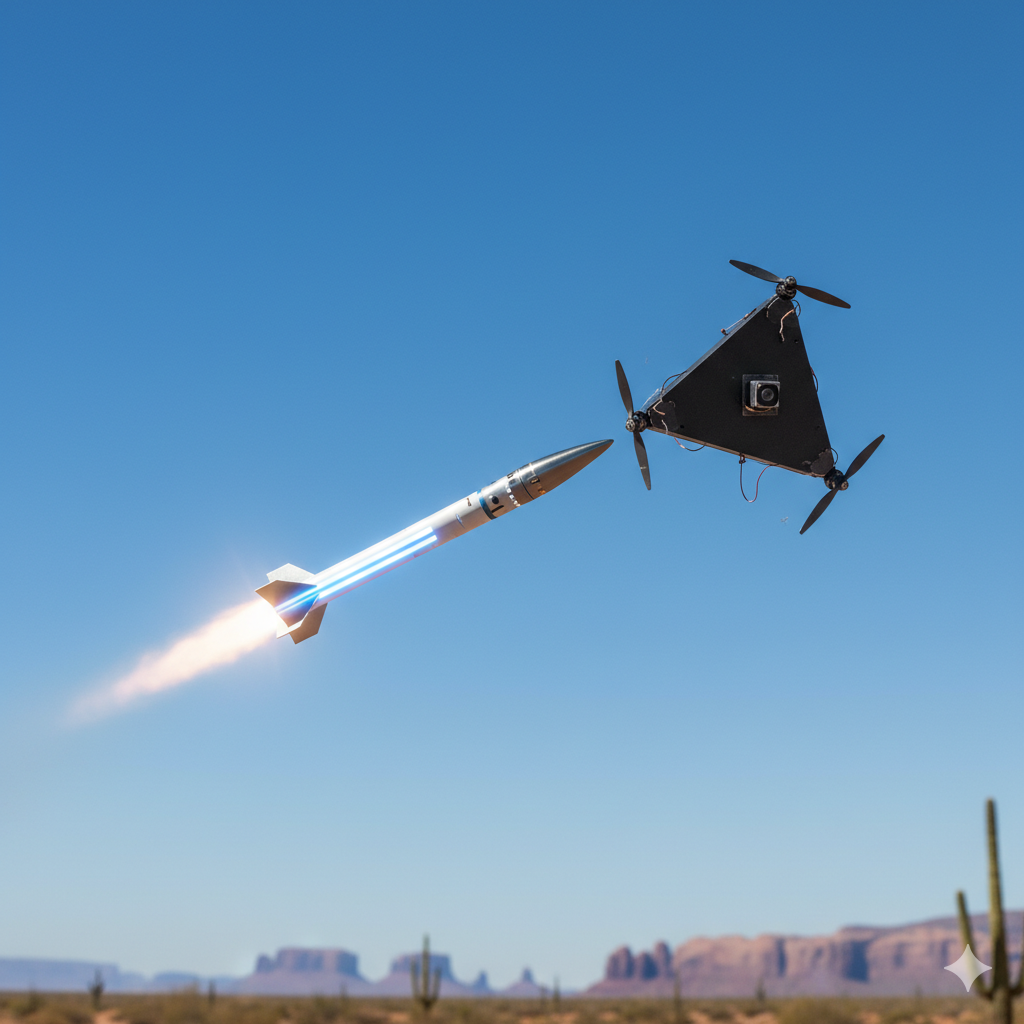 Cost ratio: 667 to 1. For each swarm of 50 drones intercepted, the US spent $100M. Iran spent €150,000.
What is the Bear Steepener and Why is it the Worst Scenario?
The Bear Steepener is the most feared move in fixed income markets. It occurs when long-term interest rates rise FASTER than short-term rates. It is not a growth signal: short rates don't fall because the Fed can't cut without stoking inflation, and long rates rise because the market doubts the US's ability to service its long-term debt.
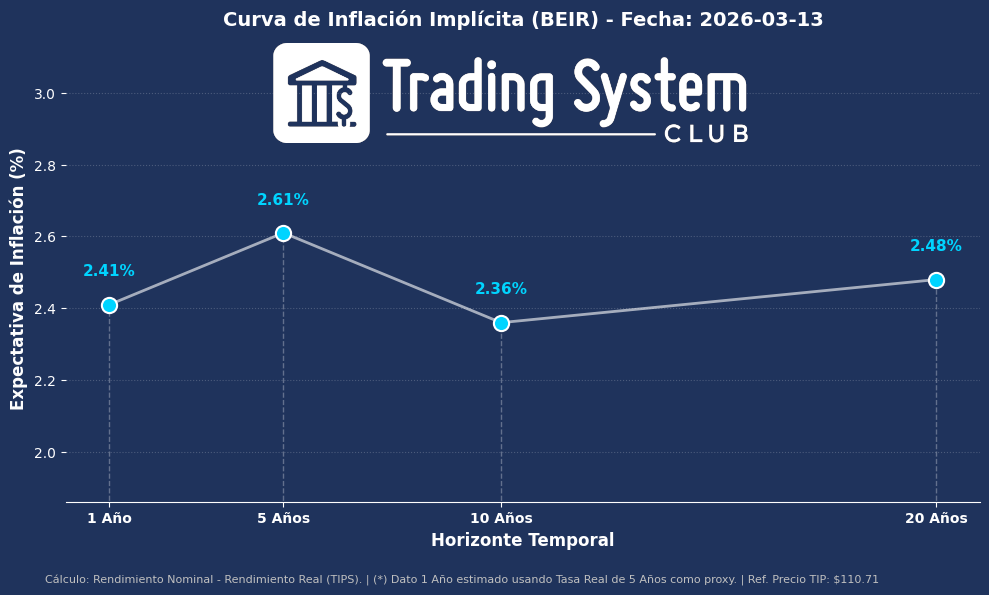 BEIR curve at 2.61% at the 5-year peak — the signal the bond market sent before the Hormuz Theorem. Full analysis at:
The Deflationary Mirage →
BEIR curve at 2.61% at the 5-year peak — the signal the bond market sent before the Hormuz Theorem. Full analysis at:
The Deflationary Mirage →The curve spread widened +13.9 bps in just 5 days. Bond Vigilantes have returned. The 30-year bond is about to cross 5%.
📊 For the full anatomy of the Bear Steepener and BEIR curve, read: The Deflationary Mirage →
The Fed Trap: Monetary Checkmate
If the 30-year bond decisively crosses 5.00%, the cascading impact would be automatic and brutal: massive margin calls on institutional portfolios, equity valuation recalibration (if the risk-free asset yields 5%, P/E ratios must compress), 30-year fixed mortgages above 7.5% crushing real estate, and the cost of refinancing the $8 trillion in debt maturing in 2026 spiking 35% above Congressional projections.
«Checkmate. Not from Iran. From mathematics. From their own debt and their own central bank that popped the champagne on inflation victory too soon.»
— James, EstambulI asked him directly whether he thought Iran would massacre the Gulf.
«No. They won't massacre. That would be stupid. They understand the Gulf is their shared backyard. They want the emirs to sit down and negotiate, not to drown in the desert. They're not monsters: they're strategists.»
— James, gestor de fondos, EstambulEurozone real rates were near 0% (ECB at 2.2%, inflation ~2.1-2.3%). If European inflation rebounded toward 3% due to oil, the ECB would have negative real rates. The euro would be the first victim of the Hormuz Theorem.
The cost asymmetry of the Hormuz war was not tactical, it was financial. A €3,000 drone shot down with a $2 million missile. Multiplied by thousands of weekly intercepts. The Pentagon wasn't fighting a war. It was funding the collapse of its own balance sheet in real time.
The Late Response: The Pentagon Knew
They weren't fools at the Pentagon. Since 2020 they had been circulating internal reports on «cost-imposition strategies» against Iran: how the enemy would use cheap drones to force exponential spending. They knew it. They modeled it. And in a move I must admit I didn't expect, they deployed in the region, in those very weeks of March, hundreds of their own low-cost one-way attack drone: LUCAS. Around $35,000 per unit. The 'American Shahed', as they call it internally.
«LUCAS is the most honest response the Pentagon has had in decades»
James told me when I mentioned it, «they admit that 21st-century warfare is won with scale and low cost, not with the $100 million F-35. LUCAS destroyed several Iranian launch facilities in Syria and Yemen. It worked. The problem is they reached this conclusion two years too late and twenty times the Iranian drone number too late.»
— James, gestor de fondos, Estambul, 28 de febrero de 2026I asked him directly: if the Pentagon was conceptually right with LUCAS, was it possible that the rest of the theorem would falter too? Was there a margin of error in the Iranian calculation?
«It's a good question and I'm glad you ask it. Iran executed this almost perfectly, but not perfectly. Their calculation was that CENTCOM would take two weeks to pivot toward cheap drones. It took four days. That cost them twelve launch installations they expected to keep operational in Yemen and Syria. It didn't change the outcome — the radar blindness was already done, the yuan announcement was already prepared — but it was the first sign that the adversary also learns. And that, in strategy, changes everything for the next round.»
— James, EstambulBut the system didn't pivot fast enough at the budget level. Resources remained tied to F-35s costing hundreds of millions, to aircraft carriers now withdrawn because insurance won't cover the risk, to supply chains that take years to scale low-cost interceptors. It isn't stupidity; it is the inertia of an empire that won every war of the twentieth century with absolute superiority. LUCAS was the exception that proved the rule.
🎬 ACT 6 — The Free Sample · Port of Fujairah, UAE. March 11, 2026
The Terror of the Invisible: Ten Mines
How do you stop the largest merchant navy in human history without firing a single torpedo? With ten objects that cost less than a family car, silently anchored at thirty meters depth. Fear doesn't need to explode to work.
The sea outside the port of Fujairah, in the United Arab Emirates, was frighteningly calm. That was what was terrifying. Not the storm. The calm. The absolute stillness of dozens of large-tonnage vessels that, in normal circumstances, would have sailed at dawn. Captains looked at each other from their bridges. Cargo brokers made desperate calls to London insurers. London insurers weren't picking up the phone.
Fujairah Port, March 11. Dozens of large tonnage vessels not sailing. Captains stared at screens. London insurers weren't picking up the phone.I interviewed Stavros, a Greek captain of a 180,000 dead-weight-ton bulk carrier who had entered the Gulf a week earlier loaded with Taiwanese electronic components. He had been anchored for four days.
«I am not moving this ship», he told me, with that calm of a man of the sea who has learned the ocean always wins, «until London P&I confirms active coverage. And London P&I won't confirm anything until Lloyd's Registry updates the mine map.»
«How many mines are there?» «Ten. Confirmed.» «And for ten mines everything stops?» Stavros looked at me as if I were the most naive journalist he had ever interviewed. «How many mines do you need to stop traffic? One is enough if you don't know where the other nine are.»
— Stavros, capitán griego, granelero 180.000 TPB, FujairahMaryam sent me an 18-second voice message with a broken voice from Tehran.
«Ten mines. Smart ones. None have detonated. Reuters and The New York Times just confirmed it: US sources say Iran deployed a dozen since March 9. Traffic is dead. Nobody dares move.»
— Maryam, audio cifrado desde Teherán, 11 de marzo, 08:41I asked Stavros whether he thought Iran might go as far as attacking the Emirates' desalination plants.
«The Persians are not idiots. If they destroy Jebel Ali or Taweelah, they kill millions of civilians in a week. Drinking water for ten million people in the Emirates depends on those plants. Iran knows this. And more: they trade with them every day — pistachios, saffron, ship spare parts. They are neighbors. Adversaries, yes. But not existential enemies.»
— Stavros, capitán griego, granelero 180.000 TPB, FujairahFrom the bridge, Stavros pointed toward the Gulf horizon, where half a dozen small cargo ships moved with complete normality among the stranded giants.
«You see that cargo ship? It's a bus. It's been doing the same route for twenty years: pistachios from Iran, electronics from Dubai, spare parts from Sharjah. Arabs and Iranians have been business companions for centuries. In my opinion, nobody is going to touch the desalination plants. The Persians don't want a humanitarian catastrophe. They want the emirs to sit down and negotiate. That difference is important.»
— Stavros, capitán griego, desde el puente del granelero, FujairahI looked toward the dock. 300-meter tankers anchored like beached whales. Cranes still. The smell of burnt fuel floated even inside the air-conditioned car.
James, from Istanbul, sent me the real-time Lloyd's Market Bulletin screenshot.
«War risk premiums for VLCCs in Hormuz: from 0.05% to 1% of hull value in 48 hours. That's $1.2 million extra per voyage on a $120M vessel. Worse than the Red Sea peak in 2025. Some insurers are already canceling coverage.»
— James, gestor de fondos, Estambul, vía Lloyd's Market BulletinThe Calling Card That Stopped the World
On March 9, 2026, Iran had deployed ten smart sea mines in the deep-water channel of the Strait of Hormuz. It didn't deny it. It issued an official communiqué stating that it had exercised its 'sovereign right to protect its territorial waters' with 'floating security devices' whose exact location could not be revealed for 'national security reasons'.
It was a work of art in psychological terror.
Ten mines. In the strait through which 21% of all oil traded in the world passes. In the channel that moves 17 million barrels daily. In the artery on which 35% of the global economy depends.
Ten mines that had not detonated. That perhaps would never detonate. Whose function was exactly what they were performing: making the cost of maritime insurance economically unviable for transit, without a single ship needing to sink.
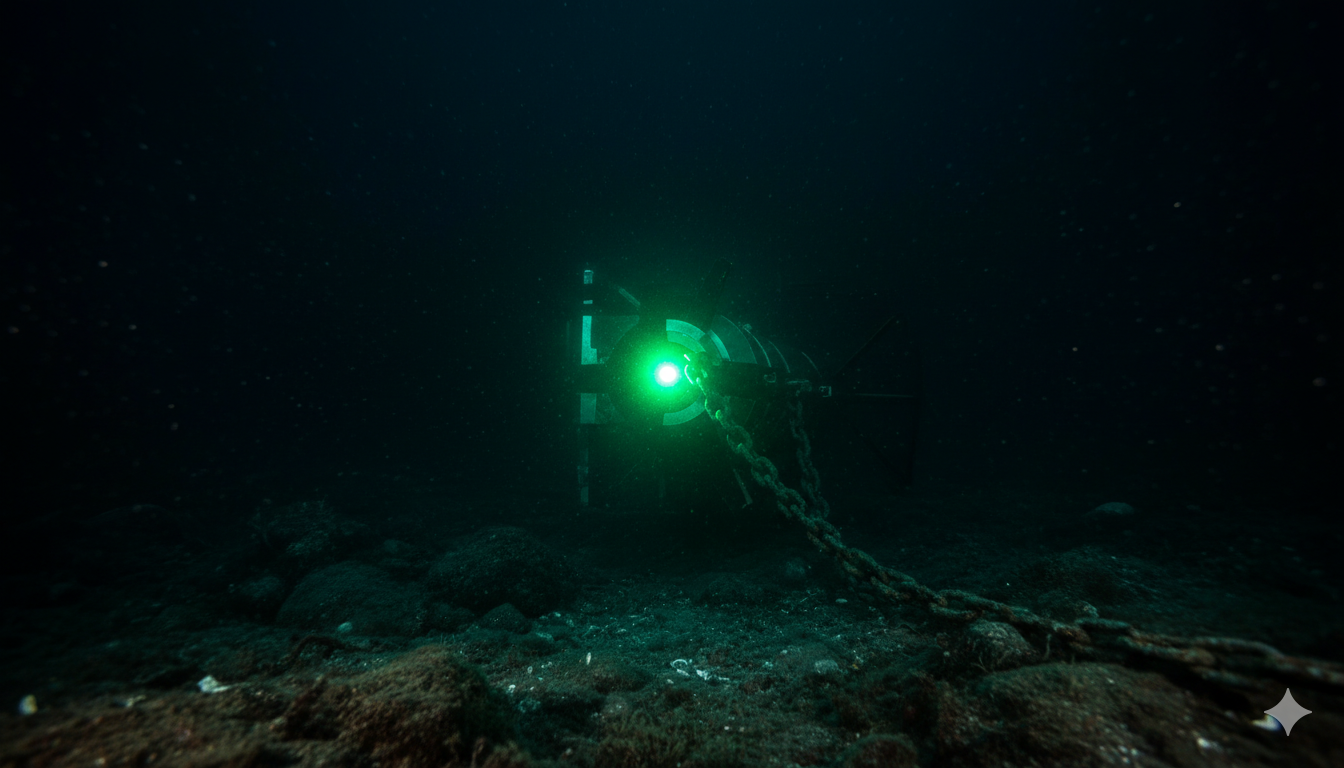 A smart sea mine. The 'calling card' that stopped 21% of global oil trade without a single one detonating.
In practical terms, transit through Hormuz had ceased to be economically viable for most shipowners. Not because the mines were going to detonate, but because no insurer wanted to risk that they might.
«We have only laid ten mines, my love. And the Strait has stopped. Do you understand now?»
— Maryam, mensaje cifrado desde Teherán, 11 de marzo de 2026Maryam finished the audio and a long silence fell on the line. Then, with a voice I barely recognized, she added:
«My love… my cousins in Bandar Abbas are working at the desalination plants. If this escalates, they'll be the first to run out of water. Do you understand now why Baba says we don't want to kill anyone? Because we are already killing our own people without firing a single shot.»
— Maryam, audio cifrado desde Teherán, 11 de marzo de 2026I hung up and looked at my hands. I was writing the fall of the empire… while my own Iranian family might pay the bill in thirst and hunger. For the first time, I hated the keyboard.
Weeks later, consulting sources at Lloyd's, I understood that Iran had calculated the insurance market would take 72-96 hours to react. The logic was that London brokers would need that time to update their risk models and communicate new premiums. What Tehran hadn't fully anticipated was the speed of the digital market in 2026: algorithmic underwriters — automated underwriting systems — revised premiums in under four hours. The Strait stopped eight hours earlier than foreseen in the Iranian plan. A minor detail in the context of the outcome, but revealing: even the most elegant theorem has its millimeters of error.
Supply Chain Collapse: Not Just Oil
The Western narrative was focused on crude oil prices. Logical: the barrel at $92 was the most visible signal. But Maryam had sent me something more in that message: a three-page analysis from her think tank on the secondary effect nobody was covering.
Hormuz doesn't only move oil. Through the Strait passes 25% of global LNG exports (Qatar), 30% of global urea and nitrogen fertilizer production (Qatar, Saudi Arabia, Iran), and thousands of industrial and food containers.
Urea is the critical component of global agricultural fertilization. Without urea, wheat, corn and rice yields fall between 30% and 50%. The Strait's paralysis in March 2026 meant the urea that needed to be applied to European and North American fields during the spring planting season would not arrive in time, or would arrive at prohibitive prices.
The 2026 autumn harvest would be, across all of Europe and parts of the US, 15-30% below normal. Food inflation would arrive with delay, but would arrive with a brutality unprecedented since the 2022 post-Ukraine fertilizer crisis.
«Hunger is the best solvent for Western democracies, my son.»
— Baba, jardín familiar (semanas antes)Verified Sources — Act 6
Lloyd's Market Association: War Risk Exclusions and Premiums
World Bank: Fertilizer Prices and Food Security
Ten mines. No more needed. The fear of the invisible is cheaper and more effective than a fleet. Insurance premiums rose 75-fold. World trade stopped. And the fertilizers that didn't cross the Strait in March 2026 mean the food crisis that will hit Europe in autumn.
🎬 We Are Not Monsters · Tehran, Baba's garden. March 15, 2026
Calm, Patience and Limits
I arrived at the garden in the early hours, after flying from Fujairah via Dubai on the last flight still departing normally. Baba was pruning a rose bush under the moonlight. There was no hurry in his movements. The cuts slow, calculated. Like everything he does.
«If Israel destroyed our plant in Bandar Abbas», he said without lifting his eyes from the roses, «we are not going to respond by destroying Fujairah's or Jebel Ali's. That would be barbarism. The Emiratis are Muslims, they are Arabs, but they are brothers in the Gulf. We eat from the same sea, we breathe the same dry air.»
— Baba, jardín familiar, Teherán, 15 de marzoHe sat on the stone bench and offered me tea. The garden smelled of damp earth and jasmine. The neighborhood dogs were silent. Tehran slept.
«We understand Israel. For decades they have seen threats in every shadow. They are right to be afraid: we are a real threat to their regional hegemony. But this war cannot end with crushing. It has to end with elegance. Like a divorce between adults: painful, but civilized.»
— Baba, jardín familiar, Teherán, 15 de marzoI asked him what 'elegance' meant.
«A way out for everyone. We will offer an agreement disguised as regional understanding. The conditions will be clear, but not humiliating. And the enrichment… that is not touched. Never. It is the only way to ensure the bully of the playground doesn't come back in kicking down the door whenever he feels like it. We will never use it — you know that and the world knows it — but we keep it because it is the only thing that guarantees we sit at the table as equals, not as subjects. Without it, as soon as the fuss dies down, they come back with the same threats and the same sanctions.»
— BabaThe Disguised Peace Proposal: The 7 Conditions
Baba set the pruning shears on the bench and spoke to me in a low voice, with the precision of someone who has rehearsed every word for years. It was not improvisation. It was architecture.
1. Complete withdrawal of US military bases from the region within 36 months (Qatar, Bahrain, UAE, Saudi Arabia).
2. Formal recognition of the petroyuan as a legitimate parallel channel for at least 30% of Gulf crude over the next five years.
3. Chinese security guarantee for Iran: limited mutual defense treaty, similar to Beijing's with Pakistan.
4. The Strait of Hormuz becomes an 'international maritime customs point' under joint Iran-Oman-China supervision, with a symbolic yuan toll for vessels over 50,000 DWT (humanitarian and Gulf country vessels exempted).
5. Progressive lifting of all residual sanctions (financial, oil, banking) without prior nuclear conditions; in exchange, Iran maintains its enrichment programme as an element of defensive deterrence, with voluntary transparency to the IAEA limited only to non-sensitive aspects.
6. Mutual non-aggression commitment against critical water infrastructure — desalination plants included — throughout the Gulf, with Chinese-Russian satellite verification.
7. Regional compensation fund of $50 billion (financed by China and accumulated petroyuan) to rebuild collateral damage in Iran, Lebanon and Gaza.
«We don't ask them to kneel. We ask them to leave with dignity. Israel can continue to exist, prosperous, but without being the armed sheriff of the Gulf. The US can return to being an oceanic power, not an indebted empire that lives by printing money. And we… we just want to breathe without a knee on our neck.»
— Baba, jardín familiar, Teherán, 15 de marzo de 2026«Enrichment is our rusty shield: ugly, expensive, but effective. We keep it because it is the only guarantee that they speak to us as equals. Without it, the playground bully always comes back to impose his law when it suits him.»
— Baba, jardín familiar, Teherán, 15 de marzo de 2026Iran will not attack Gulf desalination plants. Not because it cannot, but because it understands that Emiratis are neighbors, not existential enemies. Iran's strategy targets systems, not civilians. What Baba calls 'elegance' is, in fact, maximum precision: maximum systemic pain, minimum humanitarian damage. An honorable exit proposal for everyone.
🎬 ACT 7 — Flight from the Crystal Palace · Dubai, March 2026
The Weakest Link: Dubai
In 2024, they took me to see the future. It was a building in the Emirates desert with more cooling capacity than many European cities. They told me it was the home of the Gulf's Sovereign Artificial Intelligence. In 2026, that building was still standing. Nobody had bombed it. Nobody had touched a single pane of glass. But it was completely empty.
The 2024 Flashback: The Illusion of Sovereign AI
May 2024. The heat of Abu Dhabi at that time of year is the kind of heat that makes you wonder whether human architecture makes sense in that place.
I had been invited on a press tour of the new facilities of an Emirati technology consortium backed by a well-known Silicon Valley giant — whose $1.5 billion investment was being announced that same day — alongside representatives of the local sovereign fund. The Data Center occupied several blocks of an industrial estate on the outskirts of Abu Dhabi. The colossal cooling systems on the roof made a constant noise, like an entire city breathing. Inside, server racks stretched in infinite rows under an artificial blue light that had something of a technological cathedral about it.
«This is Sovereign AI. Every piece of data processed here remains under the jurisdiction of the Emirates. Zero dependence on extraterritorial servers. The emirs control their data.»
— Directivo del consorcio tecnológico emiratí, Abu Dabi, mayo 2024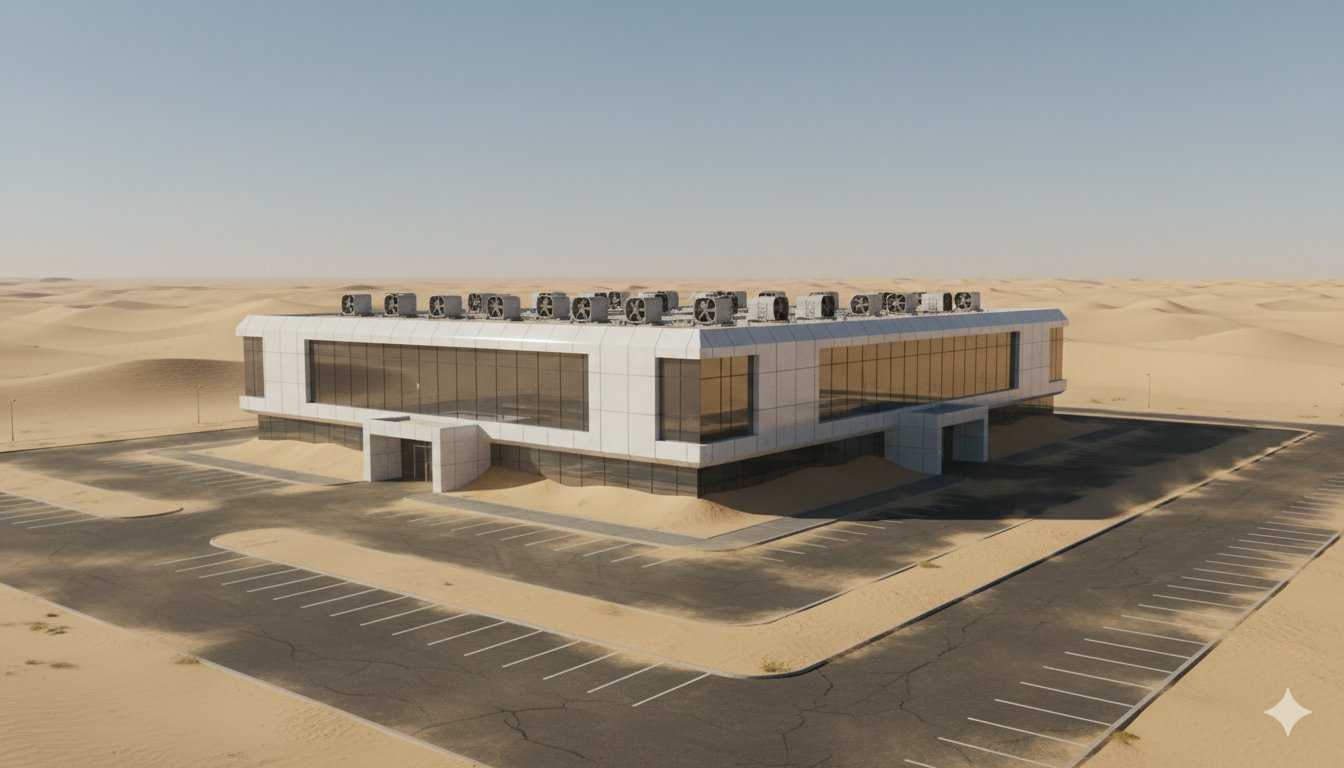 The 'Sovereign AI' data center in the desert, March 16. Racks blinking. Systems cooling. American engineers left on the 13th with the hard drives.
What the executive didn't tell me — because perhaps even he didn't know — was that 90% of the operations staff were American, European or Asian citizens. That the software layer was intellectual property registered in Delaware. That the AI inference chips were American-made, subject to US Department of Commerce export regulations.
'Sovereign AI' built on foundations that depended at every layer on the same hegemony the Hormuz Theorem was demolishing.
The Night Dubai Looked Up at the Sky
Not everything was psychological. The drones that flew over the emirates between March 11 and 15, 2026 were real. Not Shahed-136 loaded with explosives. They were fixed-wing reconnaissance drones — probably Mohajer-6 variants — that for four consecutive nights crossed the airspace of Dubai, Abu Dhabi and Fujairah at cruising altitude, photographing the data centers, port facilities and American partner installations.
None were shot down. Emirati defenders had no effective interception vectors against slow, stealthy targets at that altitude without the AN/TPY-2 radar network — the same ones that had burned in the Saudi desert days earlier. It was a field demonstration, not a threat: 'we know exactly what is here, and we know how to reach it'.
Reuters, BBC, Defense News confirmed unauthorized overflights by unidentified aircraft over UAE between March 9-15, 2026. More on the corporate response to this threat in our article: Drafted by Uncle Sam →
The Psychological Missile
On March 12, 2026, the government of the Islamic Republic issued a second communiqué that, in tactical density, was even more brilliant than the Strait regulation announcement.
Without firing a single projectile, without damaging a single square meter of private property, the communiqué catalogued all 'digital technology infrastructure owned or used by corporations of belligerent countries' located in the Arabian Peninsula as 'enemy technology and legitimate military targets in case of escalation'.
It was a perfectly calibrated threat for the type of audience it was aimed at: not the military, but the CEOs and CROs (Chief Risk Officers) of major American tech companies with installations in the Gulf. The threat didn't need to be real to be effective. It only needed to exist as a possibility in corporate risk models.
And those models said, in the following 48 hours, what they had to say: 'The risk level of Gulf installations has crossed the tolerance threshold. Activate evacuation protocols for critical assets and management personnel.'
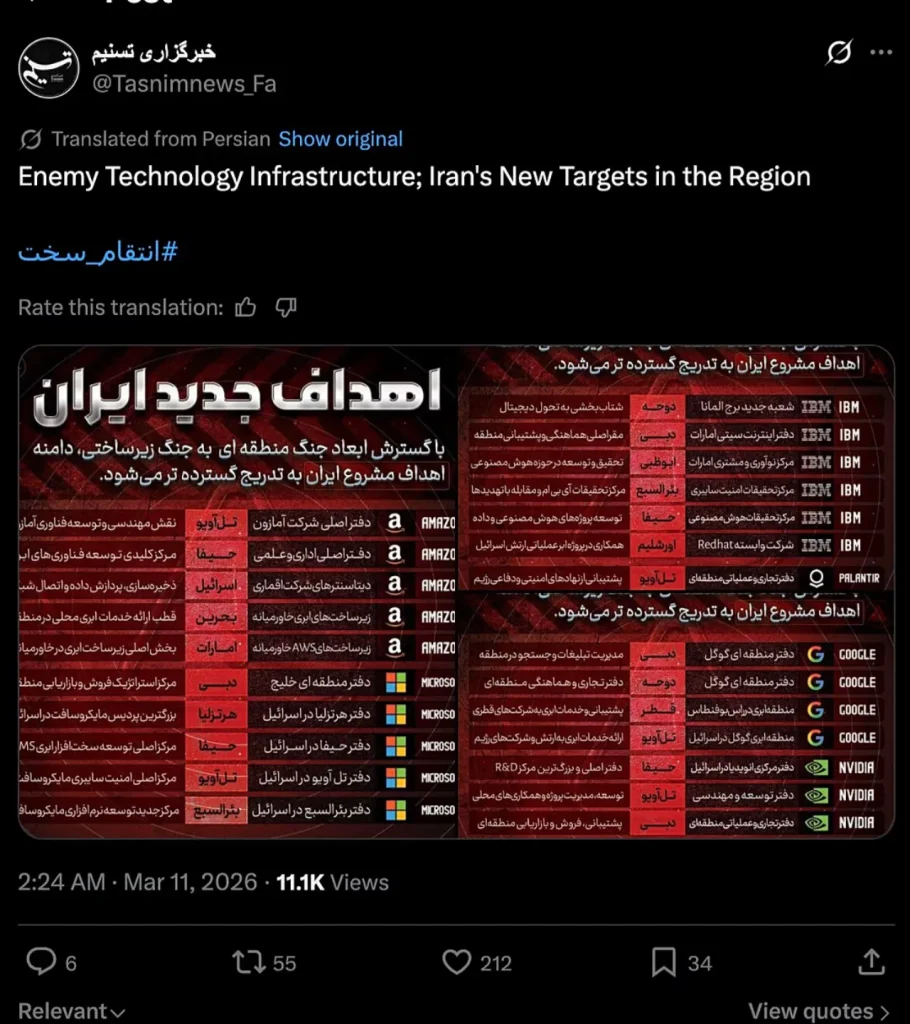 The Tasnim infographic that turned IT workers into military targets. IBM, Amazon, Microsoft, Palantir, Google, Nvidia on the list. More at:
Drafted by Uncle Sam →
The Tasnim infographic that turned IT workers into military targets. IBM, Amazon, Microsoft, Palantir, Google, Nvidia on the list. More at:
Drafted by Uncle Sam →The Silent Exit: How Capital Flees
I arrived in Dubai on March 14, hours after the Strait regulation announcement. The city appeared normal at first glance. The Dubai Mall shops were open. The Metro was running. The skyline skyscrapers were still gleaming. But there was something different in the atmosphere. A tension in which something was missing without it being obvious what.
It took me two days to understand it: what was missing was human noise. The Marina restaurant terraces were half-empty at lunchtime. The car parks of the DIFC office towers — the Dubai International Financial Centre, the emirate's financial heart — had free spaces at 10 in the morning. The private airport waiting rooms were full, but the flow direction was interesting: departures were long, arrivals were short.
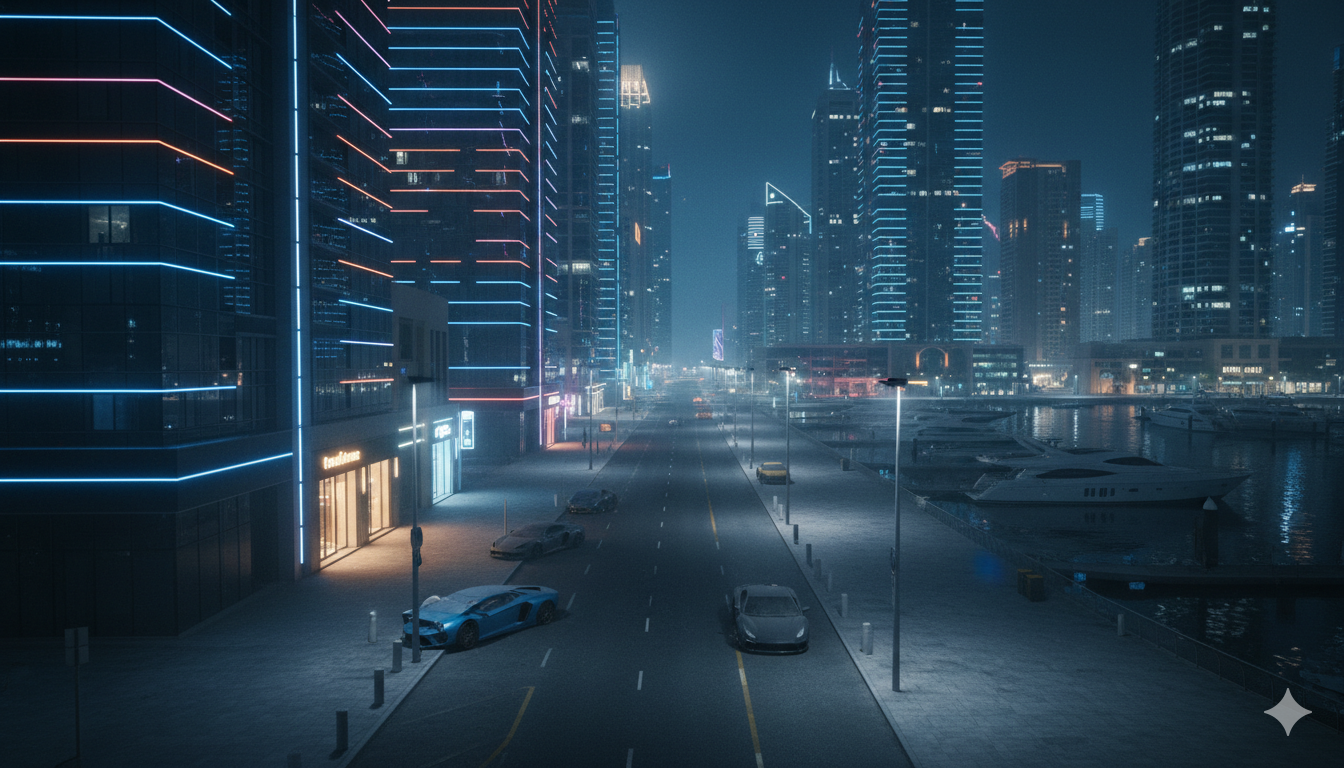 Dubai Marina, March 14. Skyscrapers still glowing. Terraces still open. But something is different: human noise is missing. Buildings shine like dead stars.
Capital and talent don't flee screaming. They don't hold press conferences. They leave in silence, transferring balances at two in the morning and booking seats on private flights to Geneva or Singapore. Executives don't resign. They 'work from home'. That 'home' is on another continent.
«It's happening what happened in Hong Kong, but faster. In Hong Kong it took three years. Here it's taking weeks.»
— Fuente del sector financiero emiratí, Dubai, 14 de marzoAir traffic data confirmed it. Private flights from Dubai to Western Europe, Switzerland and Singapore had increased 340% in the first ten days of March 2026 compared to the same period in 2025. Regular flights showed a statistical anomaly in the passenger/capacity ratio: departures were at 94% occupancy, arrivals at 41%.
The city was still spectacular. The skyscrapers were still lit. But the buildings were starting to shine like dead stars: the light arrived, but life had left long ago.
The Abandoned Data Center in the Desert
The facility I had visited in May 2024 was still there. I visited on March 16, two days before Nowruz. The security guard — a middle-aged Filipino who had worked there since the inauguration — confirmed that the last American engineers had abandoned the facility on the 13th.
«They left quickly. They took what they could. Hard drives. Some boards. They said it was routine maintenance and they'd be back. They haven't come back.»
— Guardia de seguridad del centro de datos, Abu Dabi, 16 de marzoI had to decide in that moment: publish what the guard said as a single source, or wait to verify with someone from the tech sector. I waited. I called two sources in Silicon Valley that same afternoon: they confirmed the personnel evacuation was real and coordinated. Reuters already had it but hadn't published. I was the first to make the call that confirmed the three vectors — engineer evacuation, hard drives, expired contracts — as a verifiable story. The difference between a rumor and a news item is that extra work nobody sees.
The servers were still on. The cooling systems were still roaring. The rack indicators blinked in their green and blue dance. But there was nobody to interpret what they processed, and each passing hour, maintenance contracts expired, remote authentication accesses lapsed, and what remained was hardware in a void, without clients, without operators, without purpose.
There was something deeply symbolic in that: the most advanced technology in human history, processing data in the desert silence, with nobody to read the results.
Verified Sources — Act 7
World Bank / CIA: UAE Demographics — 85%+ expatriate population
Bloomberg: Capital Flight from Middle East reporting (2025-2026)
Reuters / FT: Corporate relocations from UAE (2025-2026)
Iran didn't destroy a single Dubai skyscraper. It didn't need to. A communiqué declaring American tech infrastructure as 'legitimate targets' was enough to empty the city in ten days. Capital and talent don't shout when they flee. They leave on nightly private flights, with server racks still running, processing data for nobody.
🎬 ACT 8 — Tectonic Plates · Tehran, March 20, 2026. Nowruz.
The Hegemonic Collapse
The Persian New Year. The spring equinox festival. The oldest of documented human celebrations.Baba's garden was full of spring light. Children ran between the tables. Maryam was serving saffron rice. The general sat, calm, drinking his tea. While the world burned, he cultivated his garden.
Baba had set the Haft-Sin table with a deliberateness that struck me as almost defiant given what was happening in the markets: red apples, mirror, the goldfish in its crystal bowl. Maryam's young granddaughter wouldn't leave the fish's side, following it with her finger.
«Do you know tectonic plates?» «Of course. Basic geology.» «Geopolitics works the same way. The plates move. For decades, friction accumulates energy until the rock can't hold anymore. And then, in one second, everything is released.»
«For eighty years, the American plate held the weight of the world. The dollar. Oil. Military bases. The agreements. The SWIFT. Everything rested on that plate. We are the geological fault where the energy is released.»
— Baba, jardín familiar, Teherán, 20 de marzo de 2026. Nowruz.He watches his granddaughter playing with the Haft-Sin goldfish. His voice dropped even lower.
«We are not seeking hunger in Dubai or Riyadh. When you are denied the right to exist for forty years — sanctions, targeted assassinations, bombings — the only language they understand is that of their own losses. But the losses must be systemic, not human.»
— Baba, Nowruz, 20 de marzo de 2026He pointed at the horizon. There was a long pause. Then he added something I didn't expect:
«Enrichment gives us that equality at the table. Without it, we would go back to being the backyard where the bully comes in whenever he wants and takes what he fancies.»
— Baba, Nowruz, 20 de marzo de 2026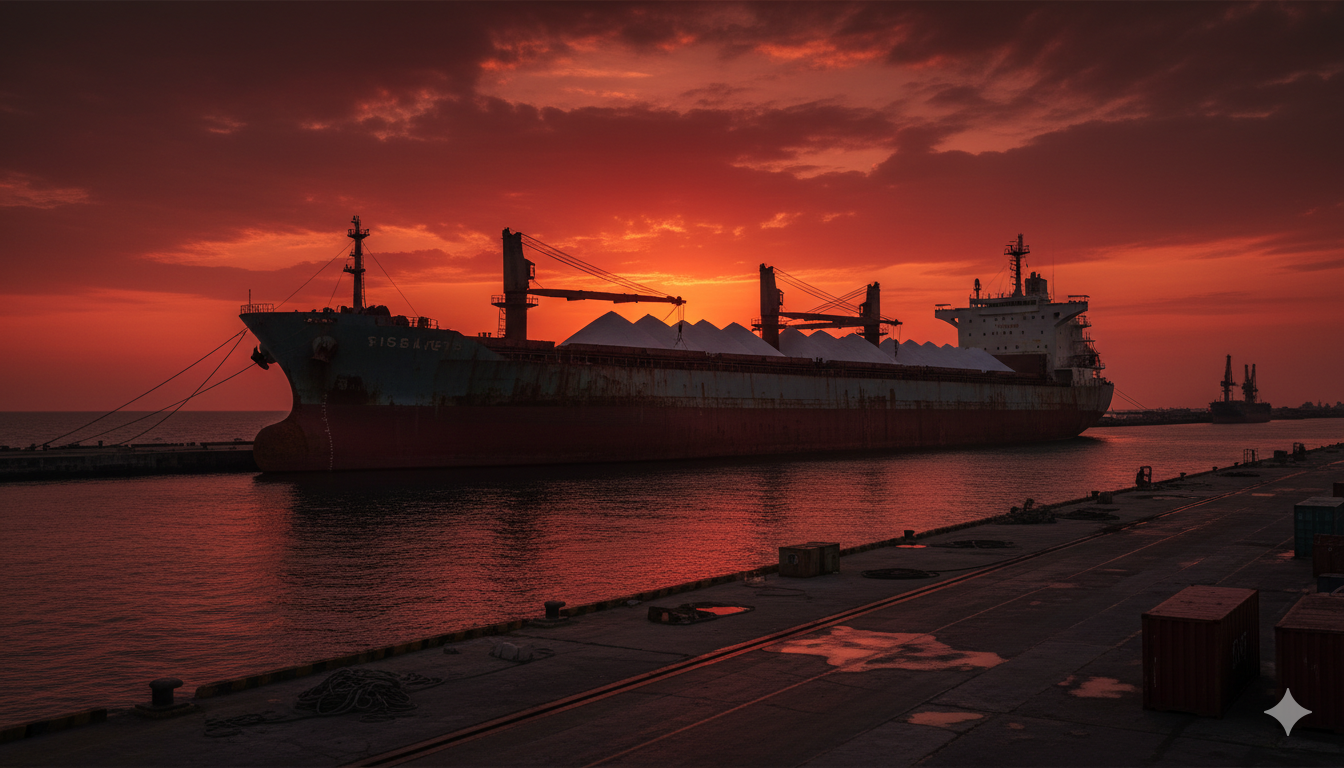 A urea cargo ship stopped off the Strait. Europe's 2026 autumn harvest is already compromised. Bread will cost three times more in December.
The Tripolar Board: Russia, China and Iran
To understand what was happening at the deepest level, you need to understand the structure of the new board. Iran is not a superpower. It knows this. Its strength is tactical and geographic, not global. What Iran has done is act as the detonator of a tectonic earthquake that two superpowers had spent years waiting for someone to trigger.
China needs the petrodollar to fall so the petroyuan has its historical opportunity. But China cannot attack the dollar directly without provoking an American economic response with unpredictable consequences. It needed someone to do it in its place. Russia, sanctioned, excluded from SWIFT, pushed out of the Western payment system, has everything to gain from a world where the dollar is not the universal reserve currency. Every day the petrodollar weakens is a day when Western sanctions lose effectiveness.
«We are the arm. China and Russia are the lungs. Without lungs, the arm can lift nothing. Without an arm, the lungs cannot strike.»
— BabaThe geopolitical trinity: Iran executes the checkmate that Beijing and Moscow couldn't make openly. China absorbs Iranian oil, provides tech components, backs the petroyuan. Russia supplies advanced military technology and implicit nuclear protection as deterrence.
The Silent Pivot of the Emirates and Saudi Arabia
Data arriving from Riyadh and Abu Dhabi in those days confirmed what Baba had anticipated weeks earlier. Saudi Arabia, which since 1974 had maintained the exclusivity of the petrodollar with an almost religious fidelity, had begun — discreetly, without official communiqués, with the elegance of someone who doesn't want to unnecessarily provoke anyone — to settle a growing proportion of its oil contracts with China in yuan.
It was not a declaration of war on the dollar. It was a risk reallocation, the kind of move that sovereign wealth managers make when their models tell them the dominant asset has lost its competitive advantage. The Emirates had been part of the BRICS since 2024. They had demonstrated sufficient frustration with the American security promise — which had been rendered worthless in the first week of March — for the loyalty calculation to begin to shift.
«They are not going to announce they are leaving the petrodollar. They will do it gradually. One contract here. One settlement there. Within five years, 40% of oil trade will no longer pass through dollars. And nobody will be able to point to the exact day it happened.»
— Baba, Nowruz, 20 de marzo de 2026History doesn't have those kinds of clear moments. Empires don't fall with a bang. They unravel in silence, contract by contract.
What is the Petroyuan and What Does It Mean for the Dollar?
If the petrodollar is the system by which oil has been sold in dollars since 1974, the petroyuan is its emerging alternative: trading energy in Chinese renminbi. To work it needs three conditions: (1) A relevant producer accepting yuan (Saudi Arabia, Russia, Iran already do so partially). (2) A payment system alternative to SWIFT (China has the CIPS). (3) A yuan oil futures market (Shanghai INE has operated since 2018).
If 20-30% of oil trade migrates to yuan: less global dollar demand → the US can print fewer dollars without domestic inflation → the American 'exorbitant privilege' is reduced → the US can no longer finance its debt with the rest of the world's artificial dollar demand.
The Strong Dollar That Buys Less
On the wall of my Madrid study, I have a chart I had reprinted months earlier that now had a different dimension in light of what was happening. It is the chart of the real purchasing power of the US dollar from 2010 to 2026. Not the DXY — the dollar strength index against other fiat currencies — but the real buying value of a dollar in terms of concrete goods and services: energy, food, housing, transport.
The DXY was high. The dollar was strong abroad. Washington boasted of it at every Treasury press conference. But taking the dollar's purchasing power as 100 in 2010, the curve reached approximately 70 in March 2026. The greenback bought 30% less than it did fifteen years ago. In energy, in food, in rent.
The United States had achieved the apparently impossible feat of having a strong currency abroad and a junk currency at home. The DXY measured the dollar against other currencies. Real purchasing power measured the dollar against reality. They were two different things.
«An Empire that spends more servicing its debt interest than defending itself has already lost the war. It's just a matter of someone explaining it to them.»
— Baba, TeheránAmerican public debt had exceeded $36 trillion. Annual debt service cost with long rates heading for 5%: more than $1.8 trillion per year. More than the Defense budget. More than all federal education spending.
The West doesn't lose because it is clumsy. It loses because its power is calibrated to crush enemies who play the same expensive game. Iran changed the rules without asking permission. And now, the world pays the bill.
The Literary Closing: The Warrior in the Garden
The afternoon of March 20. Baba's garden was full of spring light. The orange trees — the same ones that had surrounded me when he gave me the warning eight days earlier — smelled of orange blossom. Children played between the tables. Maryam was looking at her phone with a half-smile.
I sat beside Baba. I poured him tea. The silence between us had the texture of important things already said.
 Baba, Nowruz. The garden smells of orange blossom. Children play in the background. The Empire collapses in silence, as empires always collapse.
«Have you written well?» «I am trying.» «Did they understand?» «Some are beginning to understand.»
He nodded toward the children — my children, his blood, the grandchildren of the man who had designed parts of all this — running without knowing anything about what their grandfather had woven in silence for decades.
«Tell them it was necessary. That when you are denied the right to exist for forty years, through sanctions, targeted assassinations, sabotage and humiliations, you reach a point where the only language the other understands is that of their own losses.»
— Baba, Nowruz, 20 de marzo de 2026He took a long sip of tea. «And tell them something else. Tell them there is a maxim that the West forgot in its moral decadence, and that we engrave on every missile in our mountains.»
He turned to me for the first time that afternoon, and looked at me with those eyes of poetry and strategy that had given me goosebumps the first time I saw them, twenty years ago, when he was just the father of the Iranian girl I had fallen in love with.
«It is better to be a warrior in a garden than a gardener in a war.»
— Baba, jardín familiar, Teherán, Nowruz, 20 de marzo de 2026Silence. «The United States tried to be a gardener. It planted plastic democracies and military bases in our backyard. We were always the warriors.»
«Don't underestimate your enemies, Amir. They are not entirely blind nor entirely arrogant. They know that a $35,000 drone forces millions in spending. They have simulated it in wargames for years. But their doctrine is built for short, decisive wars, not for an 18-month war of attrition where each interception bleeds the global economy. They have been defeated on the board because the board changed from chess to go… and they keep moving queens while the other side surrounds them with infinite pawns.»
— Baba, Nowruz, 20 de marzo de 2026I noticed my hands trembling slightly as I took notes. Not from fear. From that feeling I have only had three times in fifteen years of journalism: of being present at the exact moment when history turns.
The Coming Year: The Food Crisis Nobody Is Covering
Baba hadn't finished. He rarely ends with the poetic phrase. After the verse comes the analysis.
«The food crisis will come in autumn. Not next year, this autumn. The fertilizers that didn't cross the Strait in March won't arrive in time for the spring planting. Europe will harvest 20-25% less grain. Bread will cost three times more in December.»
— Baba, Nowruz, 20 de marzo de 2026I asked him: «Is that a deliberate objective?» He took a sip of tea before answering. «Everything is deliberate, my son. We don't fire at civilians. We fire at systems. The European food system depends on Hormuz being open. We closed it. The consequences are the consequences. We don't seek them, but we don't mourn them either.»
It was the only sentence that chilled my blood in all the time I had been with him.
The Hormuz Theorem is proven. Not with nuclear missiles, but with mathematics, geography and patience. The petrodollar erodes contract by contract. The dollar buys 30% less than fifteen years ago. The fertilizers that didn't cross the Strait will reach the European consumer as bread at triple price in autumn. And in a Tehran garden, while children play, an old man drinks tea and no longer needs to explain anything.
Epilogue: The Remaining Question
I returned to Madrid on March 22. Madrid was the same as always: full terraces, heavy traffic, the smell of coffee at eight in the morning. The Gulf crisis was on the front page of every newspaper, but with a tone that seemed strange to me: as if it were something happening very far away, something foreign, something the 'markets were already pricing in'. They weren't pricing it in. Not fully.
What they were pricing in were first-order effects: oil price, stock volatility, interest rates. The second and third-order effects — the autumn food crisis, the slow thaw of the petrodollar, the Gulf power reconfiguration — are too complex and too slow for modern market attention cycles.
But the bond market, that market that never lies for too long, had already sent its message: the 30-year bond at 4.91%, heading for 5%. Bond Vigilantes have returned. And they have returned because the King, finally, is naked.
Before falling asleep that night, a voice message arrived from Baba. Sixteen seconds. I have listened to it many times since.
«Tell them it was necessary. But also tell them that we hate no one. We just want a garden where our grandchildren can play without fear.»
— Baba, audio, Madrid, 22 de marzo de 2026That is what I write.
Official Sources Block — Article II
📊 Macroeconomic & Monetary Sources
| Source | Data |
|---|---|
| U.S. Treasury / FRED | Curva rendimientos: 3M 3.60%, 5Y 3.87%, 10Y 4.28%, 30Y 4.91% |
| Federal Reserve / TIPS Market | BEIR 5Y: 2.61% (pico), 10Y 2.36%, 20Y 2.48% |
| U.S. Treasury | Deuda pública federal: >36 billones USD (2026) |
| Wall Street Journal | Arabia Saudí considera yuan para ventas de petróleo a China |
| Al-Monitor | Arabia Saudí abierta a comercio en otras divisas (2023) |
🌍 Geopolitical & Energy Sources
| Source | Data |
|---|---|
| EIA | 21% del petróleo mundial pasa por Ormuz (~17M barriles/día) |
| IEA / S&P Global | Qatar: 25% del GNL mundial pasa por Ormuz |
| Lloyd's Market Association | Seguros marítimos: incremento de prima 30-75x con minas confirmadas |
| World Bank / S&P Global | Crisis de fertilizantes: impacto en seguridad alimentaria global |
| Reuters | Microsoft invierte 1.500M USD en G42 (IA Soberana, EAU) |
| CSIS | Vulnerabilidad hídrica del Golfo, dependencia desaladoras |
💰 Petrodollar / Petroyuan System Sources
| Source | Data |
|---|---|
| Wall Street Journal | Arabia Saudí en los BRICS (2024) y apertura al petroyuan |
| Al-Monitor | Viraje saudí hacia múltiples divisas (enero 2023) |
| Shanghai INE | Sistema petroyuan: futuros de petróleo en yuanes desde 2018 |
| CIPS | CIPS como alternativa al SWIFT para pagos en yuan |
| World Bank | Fertilizantes y comercio global: impacto de disrupciones en Oriente Medio |
Read the Full Series Offline
Download the complete Hormuz Theorem EPUB for free — both parts in a single file. Read it on your e-reader, tablet or phone, without ads and offline.
Includes Part I and Part II · EPUB format · Compatible with Kindle, Kobo, Apple Books and moreThis story is not over. The Hormuz Theorem is a process, not an event.