
Corralito in American Bonds
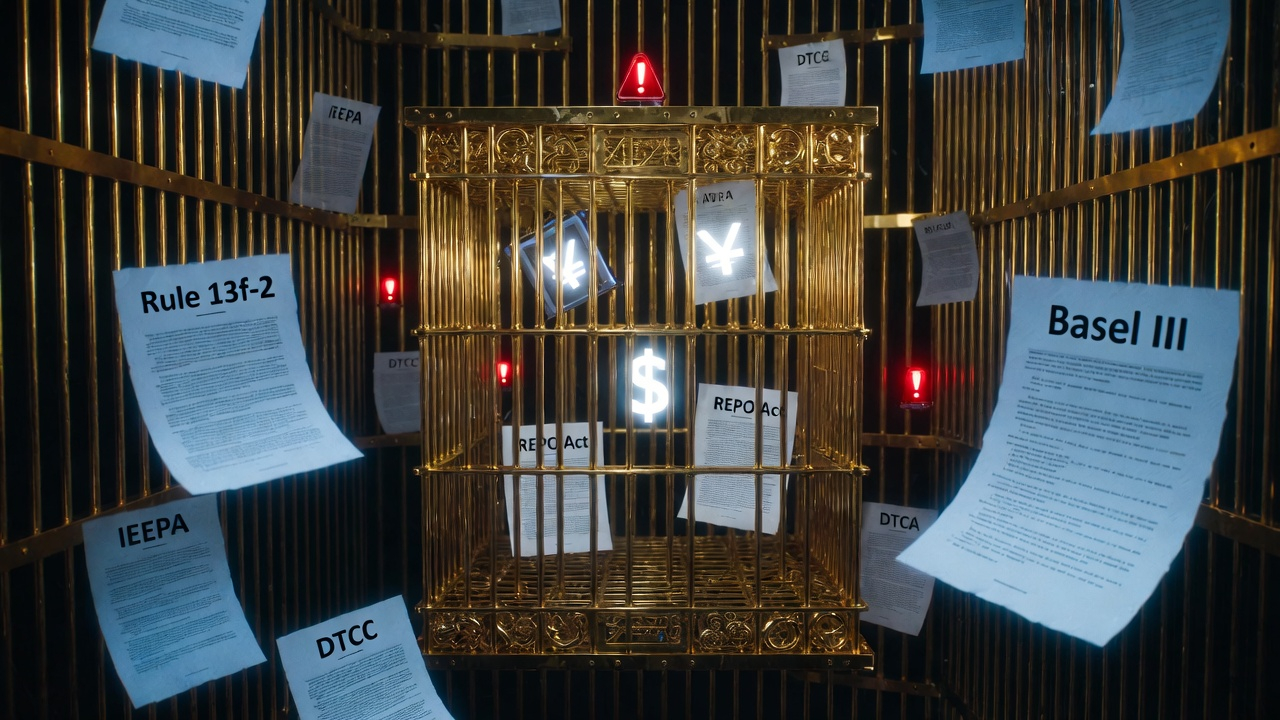
The Regulatory Framework and the Gilded Cage
Part II — The Regulatory Corralito · SEC Rule 13f-2, DTCC haircuts, REPO Act and IEEPA: five "financial stability" tools that, in practice, build the most sophisticated sovereign corralito in modern history.
III. The Regulatory Framework: How the U.S. Has Built the Fence Around Synthetic Sales
A conceptual clarification before continuing. The rules we will examine were not presented as "traps for sovereign funds trying to exit the dollar". They were presented with friendlier names: "financial stability tools", "transparency improvements" or "post-pandemic geopolitical environment adaptations". It's the difference between calling barbed wire a "perimeter security system" or calling it a corralito. The difference, in this case, is only the PowerPoint presentation.
The practical result is identical. Between 2024 and 2026, Congress, the SEC, the DTCC and the Treasury Department have built, brick by brick, a regulatory framework that knows who sells, economically penalizes you if you try to exit, establishes the legal precedent to confiscate sovereign assets, can freeze any transaction in nanoseconds via executive order, and makes custodian banks hostile to "high geopolitical risk" clients.
🔴 Tool 1 — SEC Rule 13f-2 / Form SHO: The End of Anonymity
Definition: SEC Rule 13f-2 and Form SHO
The SEC's Rule 13f-2 (approved October 2023, full implementation until January 2028 after the December 2025 extension) requires institutional managers to report monthly net short positions exceeding $10 million or 2.5% of shares outstanding via Form SHO. Data includes positions by CUSIP, daily short sale activity, and positions held more than one month.
Why it is the end of anonymity: Until 2023, a sovereign fund could build a massive short position in TLT through multiple vehicles and brokers without anyone having a consolidated picture. With Rule 13f-2, the SEC has that consolidated picture in near real-time — and shares it with the Treasury and National Security Council when there are security implications. It is financial "pre-crime": identifying the hostile actor before they fire.
Fuente: SEC.gov — Rule 13f-2 (oct. 2023) · SEC Order extensión (dic. 2025) · Proskauer — Análisis extensiones🟡 Tool 2 — DTCC / FICC Haircuts: The Liquidity Trap
Definition: DTCC / NSCC / FICC and Collateral Haircuts
The DTCC (Depository Trust and Clearing Corporation) is the central settlement infrastructure for almost all securities in the U.S. Its subsidiary FICC settles Treasury bonds and repos. Collateral haircuts are discounts that reduce the recognized value of an asset when used as collateral: if your 30-year bond is worth $100 but DTCC applies a 10% haircut, it only recognizes $90 as collateral.
2024-2025 Changes: FICC increased haircuts on long-term Treasuries to the 6-12% range depending on maturity. 20-30 year bonds receive the highest discounts. This forces deposit of additional cash — the same depreciating dollar — to maintain short positions or finance with the bond as collateral. Funds without excess cash are forced to close positions. Leverage is forcibly reduced. The trap is that if the sovereign holder does not deposit the cash, they lose access to American repo markets — a dependency they cannot easily do without.
Fuente: DTCC — SEC Rule Filings · SR-NSCC-2026-005 (DTCC, 2026)🔴 Tool 3 — REPO Act (H.R. 4175): The Sovereign Confiscation Precedent
Definition: REPO Act — H.R. 4175 (Rebuilding Economic Prosperity and Opportunity for Ukrainians Act)
The REPO Act (H.R. 4175), with its implementation version approved by Congress in September-October 2025 (Senators Risch-Whitehouse, Representative Kean), authorizes the U.S. President to confiscate foreign sovereign assets blocked under American jurisdiction and transfer them to a specific fund. As of January 2026, approximately $5 billion in Russian sovereign assets under American jurisdiction were ready for transfer to Ukraine; the total globally frozen is $280-300 billion (mostly in Europe).
Why this is the precedent that matters: The REPO Act established that sovereign immunity of financial assets on American soil is not absolute. Originally designed for Russia, the mechanism is legally extendable to any government designated as a "national security threat" under IEEPA. The $148.8B in Saudi Treasuries from January 2026 are technically within the scope of this mechanism if the necessary political conditions arise. The "gilded cage" is not a metaphor — it is legal architecture.
Fuente: Congress.gov — H.R. 4175 REPO Act · Senado Foreign Relations (sep. 2025) · Reuters — Activos rusos congelados (ene. 2026) · Wikipedia — Confiscation of Russian Central Bank Funds🔴 Tool 4 — IEEPA: The Financial Kill Switch
Definition: IEEPA (International Emergency Economic Powers Act, 50 U.S.C. 1701-1708)
The IEEPA allows the U.S. President, after declaring a "national economic emergency", to regulate or completely block any transaction in which a foreign country has an interest — including Treasury bond sales, ETF transfers, swap liquidations and any capital movement under American jurisdiction. It does not require a declaration of war. It does not require prior Congressional approval. It can be activated with a signature.
2025-2026 Use: IEEPA was already activated in 2025 to impose emergency tariffs (subject of SCOTUS controversy), and in February 2026 for new restrictions on Iran. Combined with instructions to the NSCC to delay settlements of "risk actors", it creates a regulatory limbo where capital is trapped for days or weeks while the dollar loses value. The holder remains the nominal owner — but cannot sell, transfer or mobilize their assets. That, conceptually, is a technically perfect corralito.
Fuente: Treasury.gov — IEEPA Statute · CRS Report R45618 — IEEPA (actualizado 2025) · White House — EO Irán (feb. 2026)🔵 Tool 5 — Basel III / G-SIB: Custodian Banks Turned into Gatekeepers
The Basel III capital standards and G-SIB (Global Systemically Important Banks) surcharges — driven by the Fed and BIS — require major custodian banks (JPMorgan, BNY Mellon, Citigroup, State Street) to maintain additional capital proportional to the "geopolitical risk" of their clients. In practice, this creates economic incentives to charge prohibitive custody fees to high geopolitical risk sovereign funds, unilaterally close accounts invoking compliance or AML, and slow transfer orders pending compliance review for days or weeks.
As of March 2026, there is no evidence of massive account cancellations for Gulf sovereign funds. The massive account closures of 2025 (approximately 340,000 accounts) affected expat retail clients due to FATCA/AML, not sovereign funds. The banking office evacuations in Dubai/Qatar by Citi, HSBC, Goldman Sachs and Standard Chartered (March 2026) were due to Iranian security threats, not sanctions on sovereign clients. The Basel III/G-SIB tool is currently diffuse and indirect pressure — but the legal architecture to activate it in directed mode exists and is operational.
Fuente: FederalReserve.gov — Basel III · The Hill — Evacuaciones bancarias Golfo (mar. 2026) · NYT — Citi/Standard Chartered (mar. 2026) · Medium — Purga de cuentas expat 2025📊 Table 4 — The Corralito in 5 Rules: Regulatory Framework Summary (2024-2026)
| Rule | Official Objective | Real Mechanism | Impact on Synthetic Sales | Status (Mar. 2026) |
|---|---|---|---|---|
| Rule 13f-2 (SEC) | Institutional short sale transparency | Requires reporting short positions >$10M monthly (Form SHO) | End of anonymity; detects sovereign synthetic sales | ✅ Active (full until Jan-2028) |
| DTCC/FICC Haircuts | Collateral risk management | 6-12% haircuts on long-term Treasuries; more cash required | Liquidity trap; forced closure of leveraged positions | ✅ Active (adjusted 2024-2025) |
| REPO Act (H.R.4175) | Confiscate sovereign assets from hostile countries | Transfers blocked sovereign assets to specific funds | Confiscation precedent: applicable to any hostile sovereign | ✅ Active (approved Oct-2025) |
| IEEPA | National economic emergency | Blocks any transaction with foreign interest via EO | Kill switch: freezes sovereign bond sales in nanoseconds | ✅ Active (used in 2025-2026) |
| Basel III / G-SIB | Systemic banking stability | Capital surcharges for geopolitical risk in custodians | Custodian banks hostile to high-geopolitical-risk sovereigns | ✅ Active (diffuse pressure today) |
The Corralito Quote
"You can't exit without us seeing you (Rule 13f-2). You can't stay without being charged (DTCC haircuts). You can't leave with China without us confiscating your luggage (REPO Act). And if you try to run, we flip the switch (IEEPA). Welcome to the risk-free asset of the 21st century."
— Synthesis of the American regulatory framework 2024-2026 on sovereign debt. All rules are real. All are in force.
IV. The Geopolitical Blackmail of Former Petrodollar Partners: The Gilded Cage
There is a geopolitical irony of epic proportions worth noting. The same countries that for decades bought American debt indiscriminately — financing the Treasury deficit and maintaining the petrodollar system that allowed them to collect their oil in dollars and reinvest in American bonds — are now in the crosshairs of the corralito we have described.
The United Arab Emirates and Saudi Arabia are not hostile actors in the Iranian or Russian style. They are strategic partners that have been financing the Dollar Empire for fifty years. But in 2023-2026, something fundamental has changed in their positioning. They no longer bet everything on the dollar. They are exploring — cautiously, with one hand on the door and one foot still inside — alternative settlement systems like mBridge, the BIS digital yuan, and oil purchases in yuan via triangular operations with India and Singapore.
And the American response to that cautious exploration has not been direct diplomacy. It has been the silent construction of the corralito we have just documented.
Definition: mBridge and the Petroyuan
The mBridge (Multiple Central Bank Digital Currency Bridge) is a joint project of the central banks of China, United Arab Emirates, Hong Kong, Thailand and Saudi Arabia (as observer) developed under the BIS Innovation Hub umbrella. It allows settling international payments directly between participating central banks using central bank digital currencies (CBDC) — without the need to go through the SWIFT system or use dollars as an intermediary.
The Petroyuan is the concept of pricing oil — or at least part of it — in Chinese yuan instead of dollars, which would break the structural dependency of the petrodollar system. Saudi Arabia began selling small quantities of oil in yuan to China since 2023-2024. In 2025-2026, negotiations to expand this mechanism are active but discreet.
Why it matters for the corralito: If the transition toward mBridge and the petroyuan accelerates significantly, Gulf countries' need to maintain large reserves in American Treasuries diminishes. Less need for Treasuries = more incentive to sell. And more incentive to sell = more potential activation of the regulatory framework described in Section III.
Fuente: BIS Innovation Hub — Proyecto mBridge · Forbes — Reducción inversiones Golfo (mar. 2026)🛢️ The Silent Exit Strategy: Maintaining the Appearance, Reducing the Exposure
The key to understanding the behavior of Gulf sovereign funds lies in the Treasury Department's TIC (Treasury International Capital) data. This data shows official Treasury holdings by country. And the irony of the most recent available data is striking: Saudi Arabia increased its Treasury holdings to $148.8 billion in January 2026, according to January 2026 TIC data. A record number. Published in official communications.
And how does that fit with what we have seen in previous sections? It fits perfectly — and that is the sophistication of the strategy. As we explained in the previous article "La Salida Sigilosa" (8-enero-2026), los grandes tenedores soberanos pueden mantener el bono físico en sus libros (visible en TIC Data) mientras abren posiciones cortas equivalentes en derivados offshore — TRS, opciones put sobre TLT, futuros en mercados no americanos. El resultado económico es una exposición neta al dólar cercana a cero. El resultado en los datos oficiales es que "siguen siendo grandes compradores de Treasuries".
"Officially they remain in TIC Data; financially they have already left." The silent exit is the mechanism for gradual disconnection from the petrodollar system that does not detonate yields, does not activate confiscation and does not break diplomacy — as long as it lasts. Rule 13f-2 is designed to detect exactly that discrepancy between what TIC Data says and what offshore derivatives do.
⚡ The Asymmetric Risk: The Double Trap
Gulf sovereign funds are trapped in a double trap of asymmetric risk that has no clean exit:
Option A: Sell the Physical
Colapso inmediato del precio del bono → yields disparan → daño a sus propias reservas restantes
Visible en TIC Data → señal política hostil → posible designación OFAC
Riesgo de confiscación bajo REPO Act si hay deterioro de relaciones diplomáticas
Option B: Use Synthetics
Ahora son auditables bajo Rule 13f-2 → fin del anonimato
DTCC haircuts + colateral calls → trampa de liquidez → costes prohibitivos
Posible "impuesto de estabilidad" (propuesta legislativa en circulación) → confiscación del 80% de las ganancias
What remains is the third way — the only one that does not directly activate the corralito: triangular purchases. Sell oil in yuan to China, have China pay through banks in Singapore or India (outside OFAC jurisdiction), and use those yuan to buy gold in Shanghai or London Metal Exchange. Without touching the American settlement system. Without appearing in TIC data. Without activating Rule 13f-2. It is the slowest, most expensive and most logistically risky exit — but it is the only one not yet completely closed.
Verified news — March 2026: Banking Evacuations in the Gulf
Citi, HSBC, Standard Chartered and Goldman Sachs temporarily closed or evacuated offices in Dubai and Qatar (March 11, 2026) due to security threats related to Iran — not due to sanctions on sovereign clients. It is a relevant contextual data point: the main custodian banks for Gulf sovereign funds are operating under security threat in the region, adding a layer of operational uncertainty over asset custody.
The Gilded Cage of the 21st Century
"The Sheikhs are playing chess with pieces the opponent can confiscate. The cage is comfortable — the bonds yield, the petrodollars flow, the diplomatic relations hold. But the cage has a key. And Washington holds the key. As soon as the Sheikhs move too far toward the yuan, someone will turn that key."
V. Conclusion: The War Room in March 2026
The corralito is already operating in silent mode. There have been no massive confiscations of Gulf bonds. There have been no spectacular TLT squeezes. There have been no headlines about "collapse of the petrodollar system". And exactly that — the absence of visible drama — is the signal that the corralito is working. An effective corralito is not noticed until you try to exit.
Let us summarize what the data clearly shows:
Short interest in TLT is historically elevated (23.27%, $10.45B notional on 13/03/2026) and the TLT+IEF+SHY accumulated total is $14.38B
The real pressure is between 20 and 55 times greater when Treasury futures are included (leveraged funds net short $300-800B notional according to CFTC)
The 27/02→13/03 anomaly (price falls, SI falls) signals sovereign long capitulation, not speculator closure
Minimal FTDs (12,600 shares on 26/02/2026) signal artificial liquidity — the Fed absorbing selling pressure in silence
The regulatory framework is armed: Rule 13f-2, DTCC haircuts, REPO Act, IEEPA, Basel III/G-SIB — five traps ready to activate
💥 The Bidirectional Risk: The Potential Short Squeeze
The analysis so far has focused on bearish risks. But there is an equally important risk in the opposite direction: the short squeeze. With Open Interest in Treasury futures at historic highs (~36.3M contracts in February 2026) and leveraged funds net short between $300B and $800B in notional equivalent, any factor forcing mass closure of short positions would trigger an explosive rally in TLT.
Possible squeeze catalysts: (1) a massive Fed intervention buying Treasuries (new QE), (2) a geopolitical escalation generating "flight to quality" toward American bonds, (3) an unexpectedly aggressive Fed rate cut, (4) activation of the IEEPA or REPO Act blocking short position liquidation by "hostile" designated actors. The 2.4-day DTC in TLT suggests a disorderly unwind could occur in less than three sessions.
🎯 War Room Checklist: What to Monitor in April-June 2026
Active Stress Indicators
FTD in TLT: If it sustainably exceeds 0.1% of float → real liquidity stress, not artificial
TLT long options Put/Call Ratio: If it exceeds 4:1 → extreme synthetic pressure, possible flash crash
Form SHO publications: First consolidated reports after Rule 13f-2 implementation → will reveal actors
COT leveraged funds: If net short exceeds $900B equivalent → maximum squeeze risk zone
Resolution Indicators
TIC Data vs. Short Interest: Growing divergence between official holdings and SI → confirms silent exit in progress
MOVE Index: Implied volatility in Treasuries. MOVE >130 with rising FTD = dangerous combination
TLT Price vs. $80: Critical level. Below this, the U.S. pension system enters technical insolvency
OFAC / DTCC filing news: Any new NSCC rule on collateral for foreign sovereign bonds
📐 Positioning: Duration-Neutral with Hedges
In this environment, maintaining long duration without hedging is betting that the Fed has total control and will maintain it indefinitely. The data suggests that this control has a growing cost — and that at some point the market will stop believing it. The risk management recommendation is:
Duration-neutral: offset long duration (TLT) with CME futures shorts or TLT puts to neutralize interest rate risk without exiting the market
Convexity hedge: MOVE options (OTC) or swaptions to capture extreme bond volatility scenario without a pure directional position
Do not look only at MarketBeat: ETF short interest is the thermometer, not the diagnosis. The diagnosis lies in the COT, MOVE, FTDs and Form SHO publications
Monitor the regulatory framework: any new DTCC/NSCC filing on long-term bond haircuts or changes in settlement rules is more important than the next inflation data point
"The American corralito in bonds is not the outcome of a crisis. It is the preventive management mechanism of a crisis that has already begun. Understanding the mechanism is the difference between being a victim of the corralito and being the one who operates it from the outside."
War Room: Tools to Navigate the Corralito
The data you have read points to a bond market in structural transition toward a new risk regime. Passively managed portfolios with long duration and no hedges are exposed to this environment. Our strategies are designed to navigate exactly these scenarios.
Full Market Melt Down: portfolio that mixes Long VIX insurance with tactical shorts to capture convexity in bond and index shocks.
Blue Income: portfolio of long trading systems in stocks that efficiently captures trends. No derivatives used.
Last Report: the updated analysis of positioning and risk metrics for the current environment.
Read the Full Series Offline
Download the complete Hormuz Theorem EPUB for free — both parts in a single file. Read it on your e-reader, tablet or phone, without ads and offline.
Includes Part I and Part II · EPUB format · Compatible with Kindle, Kobo, Apple Books and more📋 Official Sources — Part II (Regulatory Framework and Geopolitics)
Regulation — SEC
Regulation — DTCC / NSCC / FICC
Congressional Legislation — REPO Act and IEEPA
Banks, Custody and Gulf Geopolitics
Russian Sovereign Assets — REPO Precedent
mBridge / Digital Yuan / Petroyuan
Related Articles from Trading System Club